Last updated: 23 Jul 2026
Engaging with the prison network
The homebuilding sector’s future depends on our ability to think differently about where talent comes from. By connecting with the prison network and people with convictions, HBF members can lead the way in building not only homes, but futures.
HBF has worked with prisons and its collaborators to develop this practical guidance, which provides information on how to engage with the prison service, engage with organisations that connect employers with prisoners and ex-prisoners, and offers advice for employers on recruiting individuals with criminal records. Together, we can unlock new skills, reduce reoffending, and ensure a stronger, more resilient workforce for our industry.
Useful external links from this guide
Introduction
Addressing the homebuilding industry’s growing skills shortage requires widening our talent pipeline and opening doors to groups who have historically faced barriers to employment. One of the most impactful opportunities lies in engaging with the prison network and people with convictions. Thousands of individuals leave prison each year with the motivation to rebuild their lives, many possessing valuable skills, or the potential to develop them, through training, education, and structured rehabilitation programmes. Yet, despite this potential, they often struggle to access meaningful employment due to stigma and limited employer connections.
For the homebuilding sector, this represents a largely untapped and highly capable workforce. By creating pathways into our industry, we not only diversify our talent pool but also contribute to safer communities, as stable employment is proven to significantly reduce reoffending. Partnering with the Prison Service and organisations working with people with convictions allows employers to unlock this talent, fill critical skills gaps, and support positive social change while enabling HBF members to break down barriers, tap into untapped potential, and strengthen the pipeline of skilled workers our industry critically needs.
Working with the prison service matters
Support for employers wishing to engage with the prison service and people in custody has increased and improved.
This guide explains how to connect with prisons through a coordinated support network and how to access a motivated, skilled workforce, from labourers and tradespeople to site managers, while helping individuals rebuild their lives and contribute positively to society.
You are connecting with networks who can identify and connect prisoners/ex-prisoners to work opportunities in the right places to fulfil your workforce needs.
This guide will help you identify and connect with the right prison based on your specific workforce needs.
Social and community benefits
Reduced reoffending
Employment significantly reduces the likelihood of reoffending and individuals with a job on release are less likely to return to crime, contributing to safer, more stable local communities.
Supporting families
An employment opportunity in homebuilding can transform not just one life but many. Each year an estimated 200,000 children have a parent in prison. Post-release employment opportunities for those parents can make a huge difference to families and communities.
The business benefits of recruiting prison leavers
Find talent
Around 50,000 people are released from prison each year. Many worked successfully before prison. Homebuilders can tap into a diverse talent pool of individuals with a wide range of backgrounds, life experiences and transferrable skills.
Delivering social value commitments
For construction businesses, engagement with prison-based employment programmes directly supports Section 106 and planning obligations, client social value requirements, and ESG and sustainability frameworks.
Save money
Businesses that recruit and employ this way earn loyalty from offering people a second chance. Employers report people staying with them for longer than average. This reduces recruitment costs and increases staff retention.
Businesses agree prison leavers they employ are
- Motivated (93%)
- Trustworthy (91%)
- Loyal (89%)
- Reliable (88%)
Collaboration in practice
HBF has outlined how the industry can work with New Futures Network, Fair Chance Business Alliance, and Prisoners Building Homes.
National programmes and sector-based training programmes are available. You can also research local community partnerships in your area/s of operation.
New Futures Network
HBF are partnering with New Futures Network (NFN), a specialist employment team in the HM Prison and Probation Service (HMPPS) to support housebuilders in finding new talent and address skills shortages across construction through the prison networks. As an employer, you may have questions about working with people in prison and employing prison leavers.
New Futures Network is the specialist employment team in HM Prison and Probation Service (HMPPS). They support employers of all sizes across England & Wales to tap into a nationwide talent pool of prisoners and prison leavers, with invaluable knowledge and skills to fulfil your hiring needs and offers a no-fee recruitment service.
To hear from the Minister for Prison, Probation & Reducing Reoffending and the CEO of New Futures Network watch these videos.
How New Futures Network can help employers
- By working with you to understand the needs of your business and link you with other similar employers who have recruited prison leavers.
- By connecting you with prisons and guiding you through the process of recruiting prison leavers.
- By linking you with partners such as the many excellent charities who support prisoners and prison leavers with a range of needs before and after release.
- By offering advice on the employment pathways available and which prisons you can recruit from, based on your business needs.
- Guiding you through the process of identifying suitable candidates, with the dedicated specialist support of prison resettlement teams.
- Supporting you to promote the benefits of employing prison leavers to your organisation and get buy-in from your employees.
Recruitment Pathways
There are various recruitment pathways you may choose to opt for, each depending on your organisation’s circumstances and needs. However, different prisons have different cohorts of prisoners, so their processes might differ slightly. NFN can help you navigate this.
The main pathways are:
Businesses work with prisons and probation to find talent and offer employment to people at the end of their prison sentence. This can include interviewing and offering jobs while people are nearing the end of their sentence. Where possible, NFN will provide recruitment support for post-release employment at no cost to you.
Businesses can offer temporary employment to serving prisoners from an open estate prison to see first-hand what individuals can offer. Suitable, risk-assessed people leave prison each day to work for employers in the community. This can be full, or part-time for up to three years (in some cases) before being released. In all cases, prisoners must be paid for their work. Employment on release can be offered, with many organisations using ROTL as an extended work trial.
Prison apprenticeships enable learners to begin a recognised apprenticeship while in custody, and either finish it or complete it in the community following release. These programmes are structured to combine workplace learning, skills development and formal training that meets industry standards, giving learners a clear route into employment.
Businesses can sponsor prisoners to undertake an apprenticeship that will lead to a job opportunity on release, and they must start the apprenticeship whilst the prisoner is still in custody. The Training provider must be on the prison framework, but the business can determine who that is. Prison apprenticeships can be delivered through RoTL from open estate prisons or in closed estate prisons when the prisoners release date is within 2 years.
For more information, view the employer’s guide to the HMPPS prisoner apprenticeships programme.
Businesses can set up dedicated commercial workspaces in prisons, which become part of their supply chains. These workspaces are staffed by serving prisoners and trade-qualified, experienced instructors who work there daily, from packaging and assembly work through to complex manufacturing and services. Prisoners gain valuable and transferable skills, experience and qualifications. HMP Academies provide spaces in prisons, hosted and branded by employers to give prisoners ‘on the job’ training in preparation for employment on release, and offering a guaranteed interview to successful graduates.
If you don’t have any current or live vacancies but want to support people leaving prison to resettle into the community, this pathway enables you to add social value to your business or engage your supply chains.
This could involve presenting to prisoners about the skills required in home building, mentoring, or supporting mock interviews to upskill prisoners before release. This could be a short or long-term programme with the prison. Prison Employment Leads work closely with Careers, Information, Advice and Guidance organisations who are contracted to support prisoners with interview preparation, including CV writing.
You’re welcome to re-contact New Futures Network through their website if vacancies become available.
Frequently asked questions
The level of support that a prisoner receives depends on their circumstances and experience.
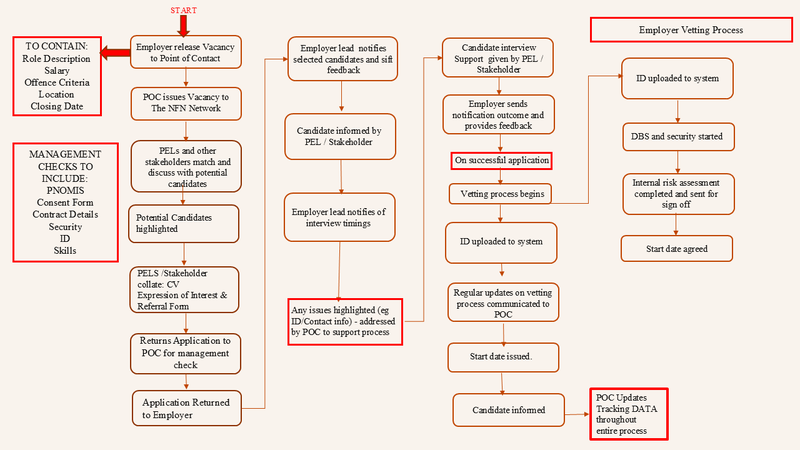
Prison Employment Leads (sometimes referred to as PELs) are recruited in all prisons that have a resettlement function. The Prison Employment Leads are specifically skilled to screen and match candidates to your role. NFN are continually developing digital tools to support prisons to match the right candidates to jobs, including the development of a digital candidate matching service.
Prison Employment Leads usually work with candidates up to 12 weeks before release to ensure they are job ready. The more specific information you can provide about the role(s), the better the Prison Employment Leads can match candidates.
Prisoners also have access to a Work Coach from the Department for Work & Pensions.
Prison Employment Hubs are managed by Prison Employment Leads, who work closely with key partners in the prison including Probation, Education and Information Advice and Guidance providers.
Employment Advisory Boards (EABs) were launched to advise, support and challenge prisons on their training and employment offer to prisoners and prison leavers, supporting more people to enter sustainable employment.
Some prisoners have extensive experience of work and require less support in this area.
Prisoners are provided with other forms of support in prison that are relevant to them, such as education or training to ensure they’re ready for rehabilitation.
NFN also offers eligible prison leavers ID and banking services, ensuring that individuals leaving prison possess the resources needed to transition into employment.
There are many brilliant charities and social enterprises that support people leaving prison, both before and after release. This support can be extremely valuable in ensuring people are personally ready for employment and able to overcome hurdles after their release too.
Wherever possible, HMPPS works in partnership with these organisations. For example, Prison Employment Leads in prisons will often refer employers and prisoners to these partners. Nationally, NFN also works in partnership with charities and social enterprises for specific employer accounts.
NFN has published guidance on disclosure, which you can find here: Publications – New Futures Network. This guidance also includes links to other organisations that specialise in this area.
NFN can train people before they’re released, to ensure they have the skills or qualifications they need to work in your business and can support you in identifying suitable candidates, setting up interviews, and any other support you might require.
Crucially, NFN can offer you a strong pool of diverse talent made up of people who have been vetted and deemed suitable for your organisation. NFN will work with your staff, who may have concerns about working alongside prison leavers, as well as deliver training for managers to ensure they are equipped to fully support prison leavers to release their full potential. NFN will Endeavor to support you and put you in contact with other organisations who can help, for as long as you employ prison leavers post-release.
To contact NFN to start your journey visit Registration Form – New Futures Network
If a placement isn’t working, the placement can be terminated. As there is no contract of employment, just a memorandum of understanding, the placement will finish the same day if you wish. If you feel the person is not right for the role but would like someone else, New Futures Network can help.
It is entirely up to you and the individual whether you agree to be transparent. It is more about how you share the information and engage with your employees. Please refer to New Futures Network for more information.
Fair Chance Business Alliance
The Fair Chance Alliance is a purpose-led, not-for-profit company, founded and funded by employers, for employers, and exists to make the recruitment of people with criminal records safe, sustainable, and normal. The Alliance makes the case for hiring and promoting people with criminal records, supported by a tiered quality standard that gives employers confidence and credibility in their inclusion practices.
Independent of government and politics, the Alliance is led by representatives from a wide range of employers working together to improve employment prospects, reduce reoffending, and build safer communities.
The Fair Chance Business Alliance (FCBA) exists to create a better, fairer future for individuals, businesses, and communities by recognising the value in every person, regardless of their past. A collaboration for change, equipping employers to unlock the potential of people with criminal records.
Focused on purpose-driven inclusion, FCBA empowers businesses to become agents of social change - achieving sustainable success while making a measurable impact on society.
Why this matters
- 9.4 m adults of working age in the UK have a criminal record (Ministry of Justice, 2024).
- An additional 545 people receive a new criminal record every day (Unlock, 2024).
- The majority of these individuals (90%) have never been to prison nor committed a violent offence (Prison Reform Trust, 2023).
- Yet, most employers still consider people with criminal records “too high risk” to hire (Business Barometer, 2024).
People with criminal records often face multiple barriers to work, including neurodivergence (Criminal Justice Joint Inspection, 2021), ethnic diversity (Ministry of Justice, 2019), and low socioeconomic status (University of Birmingham, 2021)
Provides access to underrepresented talent pools
Individuals with criminal records represent a segment of the workforce that is often overlooked. Many are motivated and skilled, seeking opportunities to rebuild their lives and contribute meaningfully to the workforce.
Provides resources and guidance
FCBA provides employers with guidance on inclusive recruitment practices, research insights, and practical tools to support engagement with people with criminal records.
Promotes policy and sector engagement
The Alliance works with employers and sector partners to improve fair chance hiring practices and contribute to positive change in employment policies and regulations.
Supports diversity and inclusion
People from low socio-economic backgrounds, ethnically diverse communities, care leavers, veterans, and those with neurodivergence are all over-represented in the criminal justice system. Integrating individuals with criminal records into employment is an important component of social mobility, diversity, and inclusion initiatives.
Collaborates with voluntary sector organisations
The Alliance collaborates with a range of not-for-profit and voluntary sector organisations to support the employment and training of people with criminal records, helping to facilitate workforce integration and sustainable employment outcomes.
To find out more visit fairchancealliance.co.uk
Prisoners Building Homes
Prisoners Building Homes (PBH) is an innovative cross-government programme designed to address housing shortages while creating meaningful training and employment opportunities for people furthest from the labour market.
The programme enables serving and post release prisoners to work alongside professional homebuilders to construct high-quality, low-cost modular and traditional homes for local communities. It also provides an end-to-end pre-development (planning) and housing delivery service to help local authorities unlock sites.
By managing the full delivery process through an innovative AI-enabled tool developed with industry partners (which PBH housebuilders can also access), the programme supports faster and more cost-effective housing delivery at scale, while allowing councils to retain ownership of their land.
PBH delivers £8.50 of social value for every £1 invested; and applies its grant funding to reduce pre-development costs for local authorities, supporting viability and delivery.
PBH is overseen by a national board that includes representatives from the Ministry of Housing, Homes England, the Ministry of Justice, His Majesty’s Prison and Probation Service, the Cabinet Office, the Local Government Association, Police and Crime Commissioners, and Local Partnerships.
Find out more by watching these videos:
Objectives and Benefits
Skills development: PBH offers accredited construction training, including the UK's first modular NVQ Level 2 (also relevant for traditional build); Level 1 Health and Safety; and CSCS cards, this helps address the chronic skills shortage, and increases labour capacity for the sector, while providing serving and post release prisoners with transferable skills, hope, and a second chance. To date 160+ people have received construction training. PBH employees are committed, loyal and productive employees; they are incredibly grateful for the opportunity.
Reducing reoffending: Acore PBH objective, providing market-relevant skills improves employability prospects which is proven to reduce reoffending. The programme boasts a significant success rate, with 89% of participants finding employment after release (compared to a 19% national average) and a reoffending rate of less than 5% (compared to a 27% national average).
Housebuilders: Are vital partners in skills partnership, with a dedicated Referral Hub assisting prisoners with job placement preparation and current vacancies. The programme has partnered with 14 housebuilders (modular and traditional) and 10 prisons.
Community Impact: As well as creating safer communities, PBH supports the delivery of affordable, low-carbon and energy efficient homes.
Landowners and Local Authorities: Are key in facilitating the programme's focus on refurbishing underutilised or surplus public sector land to accelerate housing delivery and optimise public assets. PBH has already established a significant pipeline of 1,100+ homes.
Public Sector collaboration: Collaboration across multiple public-sector partners has been essential to expanding PBH into a national, award-winning programme.

”For the last 20 to 25 years, this is the longest I’ve been out of prison. I was released in October last year (2024... I’m now living in my own flat, paying bills—and I can’t tell you how good that feels. Even getting a water bill feels like a novelty. It makes me feel normal again.
While I was still inside, I worried about how people would treat me on the outside—especially with my conviction. But when I started working at DragonHeart, it was like being with mates again. The atmosphere, the banter— it felt familiar, but in the best way. I work on the steels with Casper—he knows everything, and I learn something new every day. Emma in the office has been brilliant. Without her help, I wouldn’t have my flat.
One of the most meaningful things for me was getting paid properly. I remember getting my first real wage, and being able to take my kids to the cinema—to buy popcorn with money I earned myself. That moment meant the world to me. This programme gave me a second chance. I have a job, a home, a routine—and hope. And that’s what matters.”
Craig, former prisoner now a construction worker for DragonHeart Homes in Peterborough (who have employed and upskilled 31 serving prisoners through PBH).
Expansion Programme
PBH is on track to deliver 10,000 homes by 2029/30; whilst employing and upskilling 3,000 people. We are seeking housebuilders/development partners who share our commitment to delivering much-needed homes while helping to build safer, stronger communities.In return, PBH can support you to demonstrate:
- Social impact
- ESG compliance
- Community benefit
- Rehabilitation support
This strengthens:
- Planning applications
- ESG reporting
- Relationships with government
To find out more contact sophie.baker@dc-pcc.gov.uk or visit www.pbh.org.uk
Home builder case study
Kier Home Making Ground Programme case study
The Kier Making Ground programme is a transformative initiative aimed at providing employment opportunities for prison leavers. This case study highlights the journey of Andy Minskip, who secured employment with Moortown on HMP Millsike through the Kier Making Ground programme.
It's all down to how much you want it and the attitude you have. I really wanted it and I'm determined to succeed.
Andy Minskip, a former prisoner, began his journey with the Making Ground programme while serving at HMP Hatfield. After attending a construction event at the prison, Andy was introduced to various opportunities in the construction industry and despite having no formal training, Andy was keen to pursue a career in construction.
Upon his release, Andy joined Moortown and began working on the HMP Millsike site. Initially, he felt overwhelmed but remained motivated. Over time, Andy's dedication and hard work paid off as he progressed through various roles, including labourer, dumper driver, slinger, and groundworker. He also achieved Supervisor level, obtained a Level 3 NVQ, and completed the Black Hat Training programme, earning his site supervision (SSSTS) and site manager (SMSTS) cards.
Andy’s journey is a testament to the success of the Making Ground programme. His Project Manager, Tommy Housten, noted Andy's rapid progress and potential for leadership. Andy's commitment and honesty made him a valuable team member, and his success story underscores the importance of providing second chances to prison leavers.
Andy reflects on his experience with gratitude, acknowledging the significant impact the programme has had on his life. He believes that the support and opportunities provided by the Making Ground programme have been crucial in his rehabilitation and reintegration into society.
The Kier Home Making Ground programme has proven to be a vital initiative in breaking the cycle of reoffending and providing meaningful employment opportunities for prison leavers. Andy Minskip's story is a powerful example of how such programmes can transform lives and contribute to society.
Prison Categories


