Last updated: 3 Feb 2026
Watt a Save: The new build advantage
Examining the embedded energy efficiency of new build homes, reducing consumption, unlocking lower energy bills, and cutting carbon emissions.
Downloads and resources

Download designed assets
Member only: As part of New Homes Week, we have produced designed assets and animations for members to use across their channels
Download resources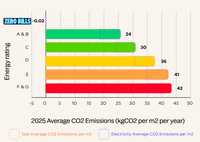
Energy efficiency overview
Figures from this report have been used to shape our energy efficiency statistics web page, an easy-to-access resource designed to highlight the most important data and messages.
SME: State of Play Report
Contents
- Foreword
- Introduction
- Features of new homes
- Going further
- Older homes
- Energy use
- Energy costs
- Carbon emissions
- Case Study: The future of living, today
- Cost of upgrading
- Impact on home value
- Customer satisfaction
- Conclusion
Foreword

Neil Jefferson, Chief Executive, the Home Builders Federation (HBF):
New homes offer a clear advantage for the people who live in them
Built to modern standards, and with energy efficiency embedded at every step, they use significantly less energy than the existing housing stock, unlocking lower energy bills, cleaner air and healthier living.
This report shows how that advantage translates into real outcomes for households. Better insulation, good ventilation, and modern low-carbon heating systems mean homes that are not only cheaper to run, but also warmer, more comfortable, and healthier to live in. While new build homes are constructed using new technologies and materials, and are built to ever evolving regulations, older homes face extensive and costly retrofit works to get to the same standard.
The report also highlights what is possible through innovation and partnership. Working with organisations such as Octopus Energy, our members are demonstrating how new homes can go even further, removing energy costs altogether to support households to reduce their consumption and lower their running costs without changing their habits.
As the UK works to increase housing supply while meeting affordability, health, and climate goals, the evidence is clear: high quality new homes are not just places to live, they are a practical route to cheaper living, healthier homes, and a low-carbon future. It is critical that the Government helps promote an environment where builders are supported to bring forward these much-needed homes without delay.

Nigel Banks, Zero Bills, Director, Octopus Energy:
A good home can change lives
When a home is energy-efficient, well-designed, and cheaper to run, it makes a big impact on people's wellbeing. Our collaboration with HBF for this report shows how modern new build homes can deliver these outcomes, and how the sector is already improving millions of lives.
With the right combination of low carbon technologies added to the mix - such as heat pumps, solar panels and a battery - we can even eliminate energy bills entirely. Octopus Zero Bills homes are already a reality for hundreds of customers who pay nothing for their home energy bills each month.
Working with HBF members across England, Wales, and Scotland, we are delivering homes that don't just cut emissions and bills, but
improve health and happiness for the long term.
Introduction
As UK housing standards improve, new homes are increasingly being built with advanced energy saving and sustainability features, marking a real shift in what residents can expect from their next property. Far from being just a "nice to have", these improvements deliver tangible financial savings, better health and comfort for occupants, and a reduced environmental footprint.
Regulations such as Part L, Part S, and the forthcoming Future Homes Standard (FHS) are transforming the way new homes are constructed, delivering cleaner, cheaper and healthier living from day one. In contrast, older homes often lack these features and can be costly or disruptive to upgrade.
Features of new homes
The list below details examples of features that can be found in new homes. Not all listed features will be found in all new build properties.
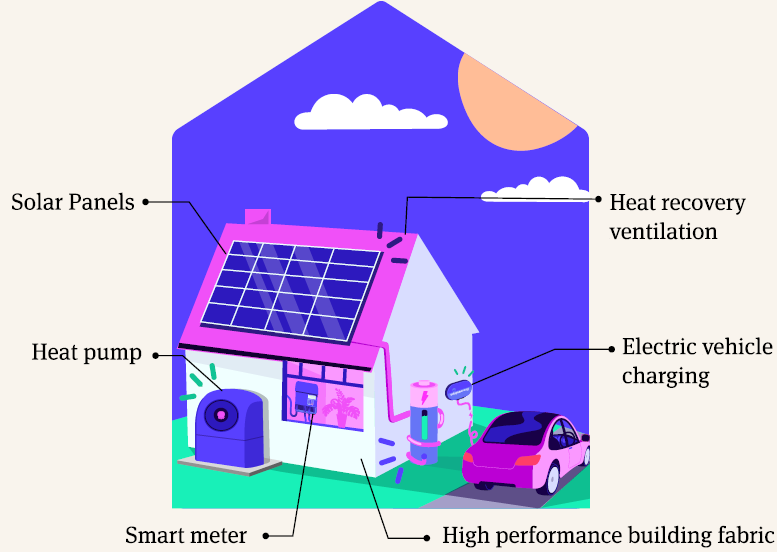
- Heat pumps: Electric heat pumps provide both heating and hot water using electricity rather than gas. They are far more efficient than conventional boilers, delivering the same warmth using much less energy, meaning lower heating bills and no combustion emissions.
- Solar panels: Solar panels generate clean, renewable electricity directly from sunlight. This reduces dependence on the grid, lowers energy costs, and cuts carbon emissions throughout the year. Under the Future Homes Standard, the overwhelming majority of new houses will be built with solar panels as the standard.
- Electric vehicle charging: With EV charging points built in, homeowners can charge their cars conveniently at home. When combined with smart tariffs, this allows for low-cost overnight charging making electric driving even cheaper and greener.
- No gas connection: Most (soon to be all) new homes are built without gas, instead connecting to the electricity grid (or a local microgrid). This eliminates on-site fossil fuel use and supports a transition to clean, all-electric living.
- Heat recovery ventilation: Mechanical ventilation with heat recovery (MVHR) captures warmth from outgoing stale air and uses it to pre-heat incoming fresh air. This improves indoor air quality, reduces heat loss, and cuts energy waste without creating uncomfortable draughts.
- High performance building fabric: Excellent insulation, airtight construction, and high-performance glazing keep warmth in during winter and heat out during summer. This fabric-first approach ensures homes are more comfortable year round while using far less energy for heating and cooling.
- Smart home hub: A smart energy hub brings all low-carbon technologies together, optimising how and when they run. By responding to real-time prices and grid conditions, the system ensures energy is used in the most efficient and cost-effective way possible.
These interconnected elements make new homes far more than just bricks and mortar - they represent a smarter, more sustainable approach to living. Cleaner heating and better ventilation leads to healthier living spaces, while solar power and zero-emissions heating reduce a home's carbon footprint. Importantly, at a time when households are facing mounting costs, these features also lead to lower running costs, therefore reducing the average energy bill.
Going futher
Building regulations set minimum performance requirements for new homes, but many home builders and clients now choose to exceed these baselines. Increasingly, projects are being delivered to higher environmental and energy standards, including emerging 'Zero Bills' approaches.
Zero Bills
Zero Bills homes incorporate substantial on-site renewable energy generation alongside solar PV, battery storage, and smart energy management systems. The aim is to offset operational energy use to the point where the homeowner can achieve zero energy bills under typical conditions.
Future Homes Hub - Sector Plan
Alongside operational efficiency, the sector is now also addressing wider sustainability issues through frameworks such as the Future Homes Hub Sector Plan. This includes tackling embodied carbon, improving resource efficiency, and integrating whole-life carbon considerations into design and construction.
Older homes
England's current housing stock is significantly older and less energy-efficient than that of many comparable European nations. As a result, a substantial proportion of homes fall short of modern expectations for safety, comfort, and environmental performance. As it stands, around 15% of English homes fail to meet the Government's Decent Homes Standard - a benchmark intended to represent the minimum acceptable quality for housing.
The UK has some of the oldest housing stock in Europe, with 38% of homes built before 1946. This is more than double the EU average of 18% and higher than France (29%), Germany (24%), Italy (21%) and the Netherlands (19%). Looking at more recently built homes, the UK still has many older houses than its EU neighbours.
Subsequently, energy bills in the UK are much higher than European counterparts. The average energy bill is 5% of the average UK salary. Hand-in-hand with the high proportion of older homes is the UK's low proportion of new homes. Only 7% of homes in the UK have been built since 2001, falling behind European counterparts including France (10.4%), Spain (18.5%), Greece (15%), Portugal (16%) and Hungary (9%).
Energy Performance Certificate (EPC) data illustrates the scale of the challenge. Over the past year, 41% of EPC registrations for existing homes were rated at D or below, while only 5% achieved the top ratings of A or B. By contrast, 87% new build properties were rated as A or B, and just 3% were assessed at D or lower. This gap reflects the advantages of modern construction, where high levels of insulation, efficient heating systems, and low-carbon technologies are incorporated from the outset.
Older homes, however, face a wide range of structural and technological barriers that undermine affordability, comfort, health, and carbon performance. Many have inadequate insulation and poor airtightness, leading to increased energy use, higher bills and great carbon emissions.
Retrofitting these features into existing buildings is both costly and disruptive. Each individual measure, whether upgrading windows, installing heat pumps, improving insulation, or adding renewable energy technologies, requires significant investment and often construction work that interrupts daily life. Taken together, the upgrades needed to make older homes net-zero-ready represent a complex and expensive undertaking.
Energy use
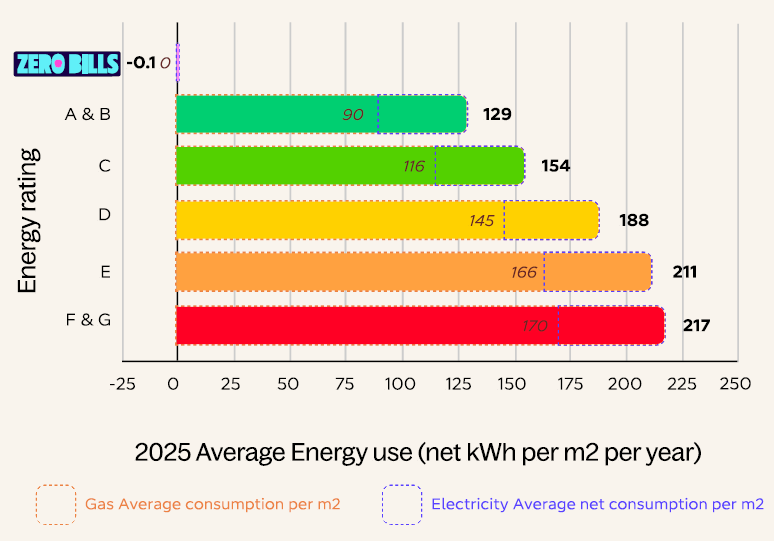
Analysis of nearly 5 million Octopus Energy customers' energy use and their home EPC ratings, shown in the image below, demonstrates that energy use steadily increases as EPC ratings worsen.
A property with an A or B rating uses 90 kWh/m2 of gas, and 39 kWh/m2 of electricity a year, on average - a cumulative total of 129 kWh/m2.
In comparison, EPC D-rated homes use 145 kWh/m2 of gas and 43 kWh/m2 of electricity a year, and EPC F and G-rated homes use 170 kWh/m2 of gas and 47kWh/m2 of electricity a year.
For the average-sized property (9om2), an EPC A or B-rated home uses 11,599 kWh of gas
and electricity in a year. In contrast, an EPC D rated home uses 16,896 kWh, and an EPC F or G rated home uses an average of 19,540 kWh.
EPC D-rated (most existing) homes used 46% more energy overall and 61% more gas than EPC A and B-rated (most new) homes. EPC F and G-rated (some existing) homes used 68% more energy overall and 88% more gas than EPC A and B-rated homes.
Zero Bills homes generated more energy than they used over the year.
Energy costs
For most consumers, the potential to save significant amounts each year on energy bills is the major draw of an energy efficient, new build home, and these significant energy savings directly translate into cheaper running costs.
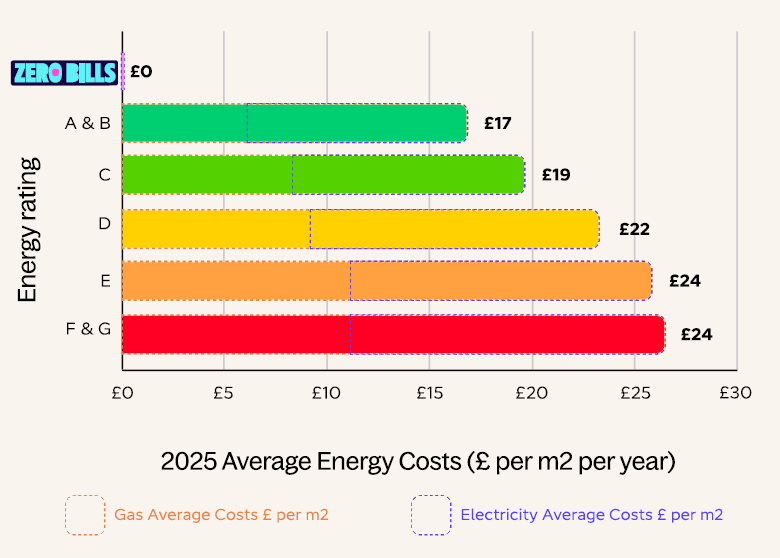
As demonstrated in the image below, energy use steadily increases as EPC ratings worsen.
Taking a 9om2 property, an A and B rated home costs £1,574 a year to run. In comparison, an EPC D home costs £1,995 - an additional £421. An EPC For Grated home costs £2,192 a year in energy bills - an additional £618.
EPC D rated (most existing) homes spent 27% more on their energy bill overall and 53% more on their gas bill than EPC A and B rated (most new) homes. EPC F and Grated (some existing) homes spent 39% more on their energy bill overall and 72% more on their gas bill than EPC A and B rated homes.
Zero Bills homes had no home energy costs at all.
Carbon emissions
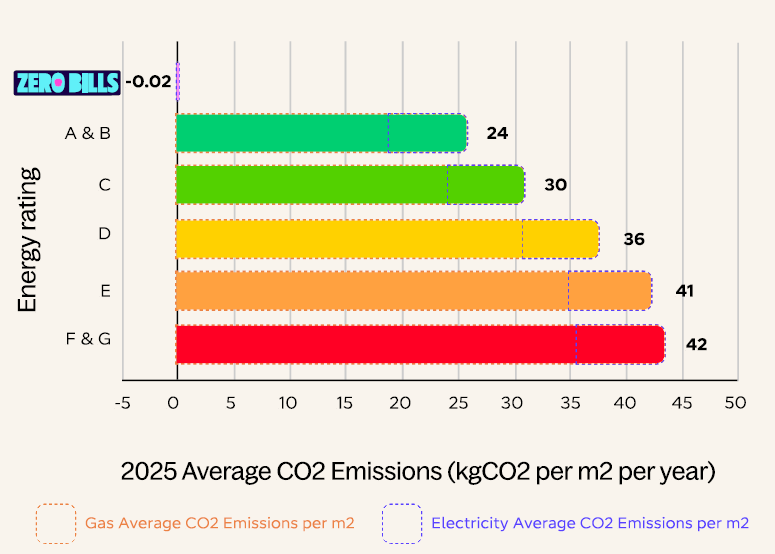
Not only does the reduction in energy usage bring significant financial savings, but also significant environmental benefits through reduced carbon emissions.
The average EPC A or B rated home emits 24kg of CO2/m2 a year, or 2,179kg per house based on the average house size of 9om2.
An EPC D rated homes emits 3,266kg a year and an EPC F or G rated home emits 3,787 kg. EPC D rated (most existing) homes had 50% higher CO2 emissions than EPC A&B rated (most new) homes. EPC F and G rated (some existing) homes had 74% higher CO2 emissions than EPC A and B rated (most new) homes.
Zero Bills homes are net zero carbon in operation.
Furthermore, this year’s survey results show that viability pressures are not confined to a particular region of the country, suggesting that the cumulative burden of policy costs is dampening development activity in all parts of England, not just those where land costs are highest.
Case Study: The future of living, today!
"Our home is warm all the time, the cost savings are noticeable"
Steve and Sarah were looking for a smart first home - one that was energy-efficient, affordable to run, and ready for the future. They found it at Thakeham's Templegate development, a sustainable community where homes are powered entirely by renewable energy and come with no energy bills for five years. Located near the South Downs National Park in Burgess Hill, West Sussex, their three-bedroom house is part of the 120-home, net zero carbon community Thakeham are building at Templegate in partnership with housing association Aster Group.
Each home features:
- Solar PV panels
- Air-source heat pump
- High-performance insulation
48 of the homes at Templegate go even further by being eligible for an Octopus Energy Zero Bills tariff. These homes also include a battery to store energy, with Octopus managing what is taken from and sent to the grid. This results in no energy bills for at least five years. Steve and Sarah chose a Zero Bills home at Templegate as their first home.
Steve, a pilot, has long been interested in renewable energy. He drives an electric car and has researched solar and heat pumps before. When he and Sarah found a home that came with everything built in, they knew it was the right choice. They paid £565,000 for the home - more than they originally planned, but saw the long-term value. It's low-maintenance, future-proof, and zero cost for energy for at least five years.
"Even the solar panels clean themselves when it rains," Steve said. "No matter what happens with energy prices, we know what to expect," Sarah added.
Before moving, they were spending about £150 a month on energy. Now? They pay nothing. Their contract ensures zero bills for at least five years.
Cost of upgrading
Not only can new build homes offer significantly lower running costs, but they also offer huge savings by removing the need to retrofit. For older homes, the cost of upgrading to include features that come as standard in new homes is huge. An overview of estimated costs can be found below.
Low Carbon Heating: e.g. Air Source Heat Pumps and cylinders
- Typical costs: £3,000 to £10,000 (after £7,500 Boiler Upgrade Scheme grant)
- Spatial considerations: External space for heat pump, internal space for cylinder and larger radiators
- Potential disruption: potential radiator and pipework upgrades
Electric Vehicle Charger
- Typical costs: £1,000 to £2,000
- Spatial considerations: External space for charger
- Potential disruption: Running cables to that location, potentially needing an external trench
Solar panels
- Typical costs: £5,000 to £10,000
- Spatial considerations: Space on roof (or elsewhere) for solar
- Potential disruption: Running cables to that location, potentially needing an external trench, potential need to upgrade roof structure
Draught Proofing and Ventilation (basic through to MVHR)
- Typical costs: £100 to £7 ,ooo
- Spatial considerations: Internal space if using MVHR for ventilation route and ductwork
- Potential disruption: Creation of ductwork routes if using MVHR
Basic insulation (cavity wall insulation, loft insulation)
- Typical costs: £1,000 to £4,000
- Spatial considerations: May need to build a platform for loft stored items
- Potential disruption: May need to temporarily relocate loft stored items, may need to repaint external wall for cavity insulation of rendered walls
Major insulation (internal wall insulation, external wall insulation, floor insulation, room in roof insulation, new windows and doors)
- Typical costs: £12,000 to £50,000
- Spatial considerations: External/internal space for solid wall insulation and room in roof insulation.
- Potential disruption: Repositioning of external or internal features for solid wall insulation (any pipes, cables, lights, switches, signs, etc), temporary relocation of furniture for floor insulation and internal wall insulation, etc.
Impact on home
Analysis by the Department of Land Economy at the University of Cambridge (commissioned by ScottishPower and WWF) examined over five million existing homes.
The findings indicate that low-carbon technologies can increase the value of a home:
- Heat pumps: £5,000 to £8,000 (1.7% to 3.0%)
- Solar PV: £1,350 to £5,400 (0.5% to 2.0%)
- EV charging points: £5,400 to £7,400 (2.0 to 2.75%)
In a separate study of five million property transactions (commissioned by Octopus Energy) the same Cambridge team found a strong link between lower energy bills and higher house prices. The analysis suggests that 'Zero Bills' homes could command a price premium of up to 16% while new homes built to current modern standards can attract a 5 to 6% premium compared to similar existing properties.
Customer satisfaction
Recent feedback from Octopus Energy customers who have installed heat pumps, electric vehicles (EVs), and solar panels show strong satisfaction across comfort, running costs, noise levels and maintenance:
- 94% report that their home feels just as comfortable or more comfortable than it did with their previous boiler.
- 85% say their heat pump costs the same or less to run. As electricity prices begin to stabilise and heat pumps become more efficient, many customers are now seeing meaningful savings.
- 86% say the system is no louder than their old boiler - an area often cited as a concern before installation.
- 89% say their heat pump is just as easy or easier to maintain, reflecting both the reliability of the technology and the benefit of simplified servicing compared to combustion-based systems.
Conclusion
New homes, designed and delivered under increasingly robust building regulations such as Part L, Part S and the forthcoming Future Homes Standard, offer substantially lower energy use, reduced running costs, improved comfort and health outcomes, and significantly lower carbon emissions.
Modern homes integrate high-performance building fabric, low-carbon heating systems, renewable energy generation and smart energy management from the outset. As a result, the average new build home (EPC A or B) uses far less energy than older properties, costs hundreds of pounds less per year to run, and produces up to 42o/o fewer carbon emissions than the least efficient homes.
In contrast, much of England's existing housing stock remains poorly insulated, reliant on fossil fuels, and expensive to heat. Retrofitting these homes to modern standards is complex, disruptive and costly, often requiring multiple interventions that still struggle to match the performance of a purpose-built low-energy home. While retrofit will play a vital role in decarbonising existing homes, it is neither a quick nor low-cost solution.