Last updated: 2 Mar 2026
Section 106 and Community Infrastructure Levy funds held by local authorities: 2026 edition
Contents
Unspent funds held by local authorities
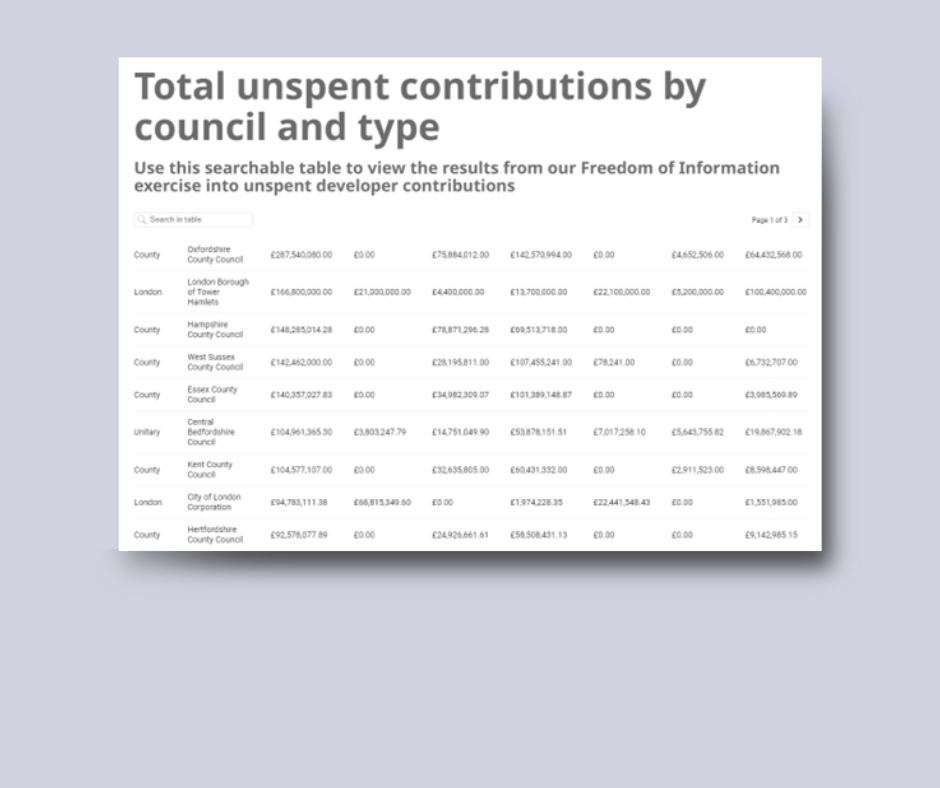
HBF member can view the full results from HBF's Freedom of Information exercise by creating or logging in to a HBF account.
View our searchable data table
Summary
New analysis by the Home Builders Federation (HBF) estimates that the total value of developer contributions held unspent by local authorities in England and Wales has increased to £9 billion, a rise of £800 million from mid-2024 despite declining housing delivery and reduced developer contribution receipts in recent years.
Based on the most comprehensive Freedom of Information (FOI) exercise to date - with responses from over 70% of local authorities - the research estimates that there is £6.6 billion of unspent funds received via Section 106 agreements, alongside around £2.2 billion raised through the Community Infrastructure Levy (CIL). This includes £700 million allocated for Affordable Housing and £2 billion for schools and education, funding which could otherwise deliver around 8,500 affordable homes and 112,000 new school places.
On average, councils hold £19 million in unspent Section 106 contributions and £14 million in unspent CIL funds. However, a small number of local authorities hold sums far in excess of the national average. The London Borough of Tower Hamlets alone holds over £260 million in unspent developer contributions – nine times the national average on a per-household basis.
The link between new development and the delivery of supporting infrastructure is also increasingly being severed. One third of unspent Section 106 contributions have been held for more than five years, up from a quarter in mid-2024, despite many agreements requiring funds to be spent within that timescale. Overall, around £3 billion of developer contributions is estimated to have been held unspent for more than half a decade.
This year’s FOI results also demonstrate that there has been a significant worsening of council transparency around the reporting of unspent developer contributions. One in four councils failed to publish details of their unspent infrastructure funds before the statutory deadline last year, compared to one in ten in 2020, undermining accountability and public awareness of the developer contributions system.
Developer contributions are a vital mechanism for ensuring that communities see and feel the benefits of new development while helping to deliver the infrastructure and amenities that help to turn a new development into a thriving community. However, there is a risk that delays to infrastructure delivery will undermine public support for new development at precisely the moment when the Government is seeking to increase housing supply to meet its ambition of delivering 1.5 million new homes.
Key findings
- An estimated £9 billion of developer contributions is held unspent - up £800 million (9%) since mid-2024.
- Almost £3 billion is estimated to have been held for over five years, despite many agreements requiring infrastructure to be delivered within that period.
- £700m for Affordable Housing and £2bn for schools is waiting to be spent.
- Local authority compliance with reporting of their unspent developer contributions has fallen from 90% to 75%.
- A small number of councils hold disproportionate sums – with Tower Hamlets holding over £260 million.
What are developer contributions?
What are developer contributions?
Local authorities require developers to make financial contributions to them as part of the process of granting planning permission. The purpose of these contributions is to mitigate the potential impact of development on local communities by funding infrastructure and amenities such as extra school facilities, health provision, open spaces, Affordable Housing, and road upgrades.
Under the current arrangements, MHCLG estimates that developers make contributions worth around £6bn per annum in total, delivering significant investment in local communities. The Competition and Markets Authority (CMA) notes that annual developer contributions receipts are equivalent to 46% of annual total expenditure by local government on housing and community development, and equivalent to the total amount spent by local government on infrastructure every year.
Two main types of contributions are made to local authorities in the process of securing planning permission:
- Section 106 agreements are negotiated between developers and local authorities and can help to make a development ‘acceptable’ in planning terms. The agreements specify contributions that developers will make to mitigate the impact of a specific development.
- Community Infrastructure Levy (CIL) is a charge which can be levied by local authorities on new development. Rather than being negotiated (like Section 106 agreements), CIL is based on a charging schedule and levy rates, which must be published on the local authority’s website. In areas where a CIL schedule has been introduced, the levy is compulsory.
Section 106 and other developer contributions are seen as a crucial part of ensuring that local communities see and feel the benefit that development brings to their area.
Total unspent developer contributions
Freedom of Information exercise
Freedom of Information exercise
HBF surveyed all types of local authorities across England and Wales to collect detailed information on unspent Section 106 and CIL funds, as well as the allocation of funds, returns to developers, and compliance with Infrastructure Funding Statement (IFS) reporting. In cases where local authorities didn’t respond to HBF’s FOI request, data was taken from the latest Infrastructure Funding Statements for 2024/25, where available.
Section 106 contributions
With data from 243 councils - 72% of all local authorities in England and Wales - this represents the most reliable estimate of unspent Section 106 funds to date.
The responses show:
- The average council holds £19.4 million in unspent Section 106 funds.
- Extrapolated nationally, there is likely to be as much as £6.6bn Section 106 monies paid to councils by home builders sat unspent.
In absolute terms, the following five councils hold the most in unspent Section 106 contributions:
- Oxfordshire County Council - £269 million
- Essex County Council - £169 million
- London Borough of Tower Hamlets - £154 million
- London Borough of Wandsworth - £142 million
- Hampshire County Council - £137 million
The top 5 councils are the same as in HBF’s 2024 report, apart from Wandsworth, which did not provide data in 2024.
Community Infrastructure Levy
With data from 75% of councils that operate a CIL (121 councils), HBF’s analysis shows:
- An average of £13.9 million of CIL funds are held unspent per council – up from £11.4m in HBF’s 2024 analysis.
- Extrapolated nationally, there is likely to be as much as £2.2bn in unspent CIL monies provided by house builders, up from £1.8bn in 2024.
In absolute terms, the following five councils hold the most in unspent CIL contributions:
- The London Borough of Brent - £178 million
- London Borough of Wandsworth - £117 million
- London Borough of Tower Hamlets - £107 million
- Wiltshire Council - £49 million
- Mid Suffolk District Council - £47 million
Including £128 million held by Integrated Care Boards (ICBs), the total estimated value of unspent developer contributions is £9 billion - around £800 million (9%) higher than estimated in mid-2024.
Worst-performing councils
To identify which councils hold disproportionate unspent sums, the responses to HBF’s FOI request were weighted according to the number of households in each local authority area.
County Councils typically hold the largest sums in absolute terms due to their geographic and population size, but weighting the results in this way offers greater insight into which councils hold disproportionately high levels of unspent contributions relative to their size and the national average. On this basis, just one county council – Oxfordshire – performed poorly.
The analysis shows that:
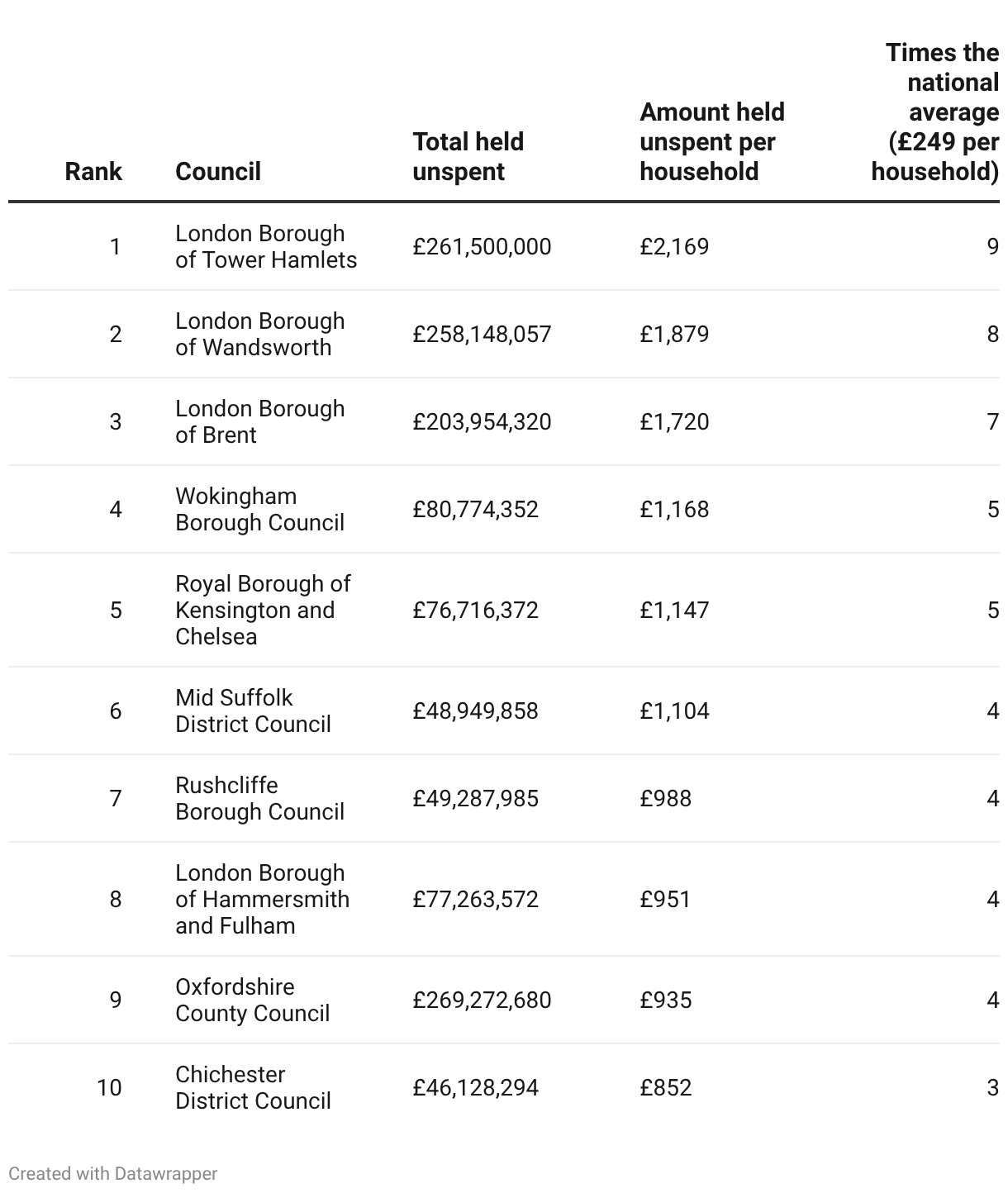
- The London Borough of Tower Hamlets holds £2,169 per household - nine times the national average and equivalent to 149% of the average local council tax bill.
- Five other councils hold over £1,000 per household in unspent contributions.
- The top ten councils with the largest amounts held unspent on a per-household basis vary according to rates of new house building and council type, although the top three are all in London.
- The average council across the country holds the equivalent of £249 unspent per household, or 14% of the average local council tax bill.
Top ten councils with the largest amounts held unspent on a per-household basis:
Council tax bills
Council tax bills
To contextualise these figures further, the amounts held per household in each local authority were compared to the average council tax bill for that area. In some areas, the amounts held unspent per household constitute a significant proportion of the average local council tax bill, with the top five all being in London.

Allocations of unspent Section 106 contributions
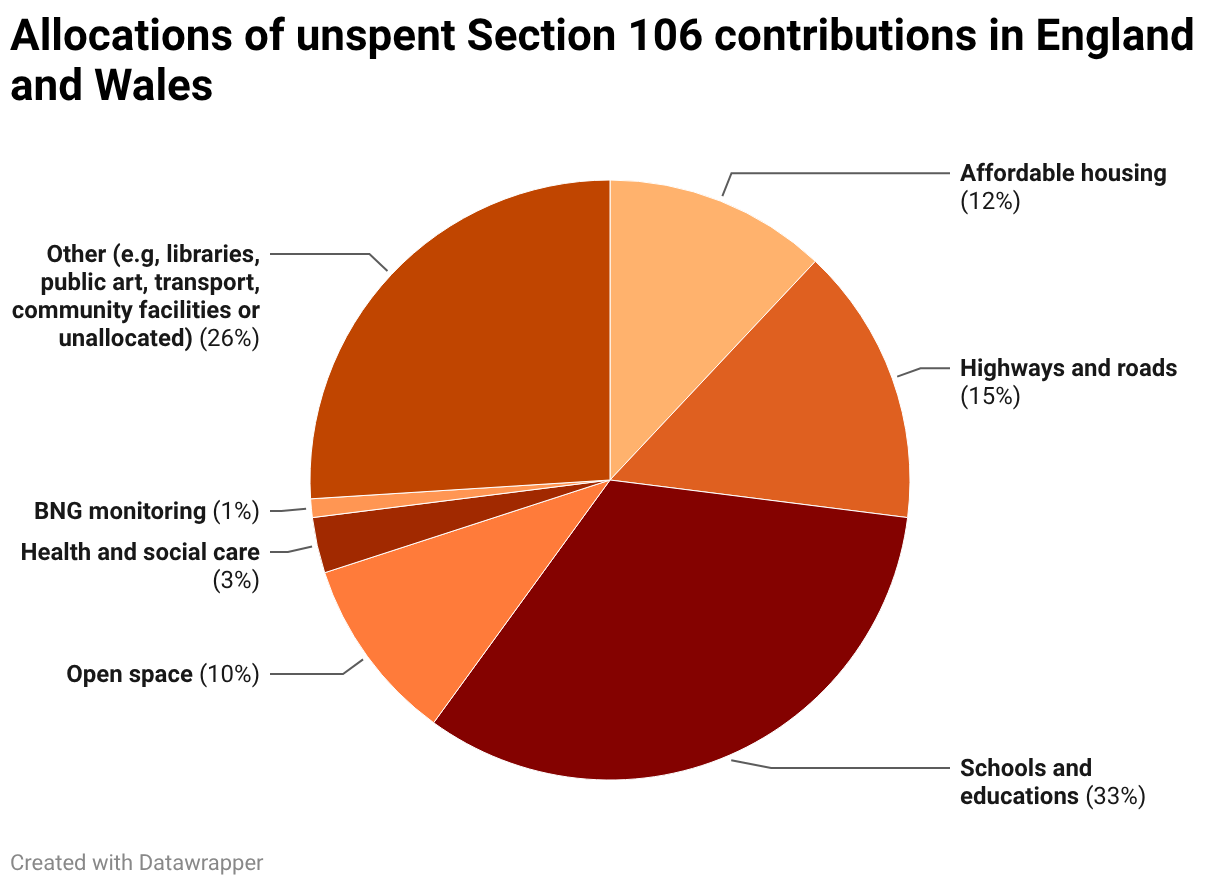
60% of councils provided a breakdown of how their unspent Section 106 contributions are allocated. Contributions were broadly allocated as follows:
Affordable Housing
- Estimate of total held unspent in Affordable Housing contributions: £709 million
- Average amount of unspent Affordable Housing contributions held per council: £2.2 million
The 10 councils with the largest amounts of unspent Affordable Housing contributions are:
- London Borough of Hammersmith and Fulham - £30.5 million
- London Borough of Tower Hamlets - £30.1 million
- Royal Borough of Kensington and Chelsea - £19.7 million
- Horsham District Council - £17.3 million
- Oxford City Council - £12.2 million
- Reading Borough Council - £10.3 million
- Newcastle upon Tyne City Council - £9 million
- Sheffield City Council - £8.9 million
- London Borough of Brent - £8.6 million
- Royal Borough of Greenwich - £8.5 million
As in previous years, our analysis shows that local authorities in major cities most affected by the housing crisis are holding the greatest amounts of money that have been allocated for Affordable Housing. Five of the ten councils with the highest amounts of unspent Affordable Housing contributions are in London, with Sheffield, Newcastle, Oxford and Reading also amongst the top ten.
Hammersmith and Fulham, which holds the highest amount of unspent Affordable Housing contributions, is the fourth most unaffordable local authority district in the country, with the average house price being 16 times average earnings (ONS).
£700 million could deliver 8,500 Affordable Homes.
Schools and education
- Estimate of total held unspent in schools and education contributions across England and Wales: £2 billion
- Average amount of unspent schools and education contributions held per council: £5.8 million
By far the largest allocation category for unspent Section 106 funds is schools and education, with a third of unspent funds allocated for this purpose.
The five councils with the largest amounts of unspent school and education contributions are:
- Oxfordshire County Council - £154.5 million
- Essex County Council - £117.9 million
- Kent County Council - £75.9 million
- Hertfordshire County Council - £71.7 million
- Hampshire County Council - £58 million
Oxfordshire County Council’s own projections show an 8% rise in secondary school pupils in the County by 2027/28, and the Council says up to 26 new schools may be needed within the County in the coming years.
£2 billion could support 112,000 new school places.
Highways and roads
- Estimate of total held unspent in highways and roads contributions across England and Wales: £915 million
- Average amount of unspent highways and roads contributions held per council: £2.7 million
The top five councils with the largest amounts of unspent highways and roads contributions are:
- Hampshire County Council - £74.1 million
- Essex County Council - £43 million
- Kent County Council - £36.4 million
- Hertfordshire County Council - £27.2 million
- Leicestershire County Council - £24.7 million
£915 million in unspent highways and roads funding equates to an average of £4,500 per mile of the highways network.
Hampshire County Council, which holds the most in unspent highways contributions, holds the equivalent of £13,500 per mile of its road network.
Open spaces
- Estimate of total held unspent in social infrastructure contributions across England and Wales: £600 million
- Average amount of unspent social infrastructure contributions held per council: £1.8 million
‘Open spaces’ includes recreation, parks and play areas. The five councils with the largest amount of unspent open space contributions are:
- Milton Keynes Council - £17.3 million
- Buckinghamshire Council - £17.3 million
- Bracknell Forest Borough Council - £16.9 million
- Cherwell District Council - £16.6 million
- London Borough of Tower Hamlets - £14.4 million
£600 million could fund 3,200 games areas or over 5,000 football pitches for community use.
Health and social care
- Estimate of total held unspent health and social contributions across England and Wales: £321 million – of which £128 million is held by Integrated Care Boards and £193 million by councils
- Average amount of unspent health and social care contributions per council: £568,000
The five councils with the largest amount of unspent health and social care contributions are:
- Milton Keynes Council - £16.1 million
- London Borough of Tower Hamlets - £6.7 million
- Central Bedfordshire Council - £6 million
- Cheshire West and Chester Council - £4.5 million
- Oxfordshire County Council - £4.4 million
The amount of unspent Section 106 funds for healthcare held by councils has grown by 30% since 2024 to almost £200 million.
Funds held by Integrated Care Boards (ICBs)
Additional developer contributions funds worth £128 million are also held unspent by Integrated Care Boards (ICBs). Councils typically transfer money to ICBs for new healthcare facilities after receiving funds from developers.
An FOI of ICBs conducted by HBF, which received responses from 100% of ICBs, shows that:
- 17 out of 43 ICBs hold unspent developer contributions.
- An average of £7.5 million is held by each of these ICBs.
- 6 ICBs report having requests to councils for developer contributions refused in the past three years, in some cases because councils have simply not responded to requests. This suggests a lack of coordination between councils and ICBs on how funds will be used prior to developers paying the funds.
Age profile of unspent funds and returns to developers
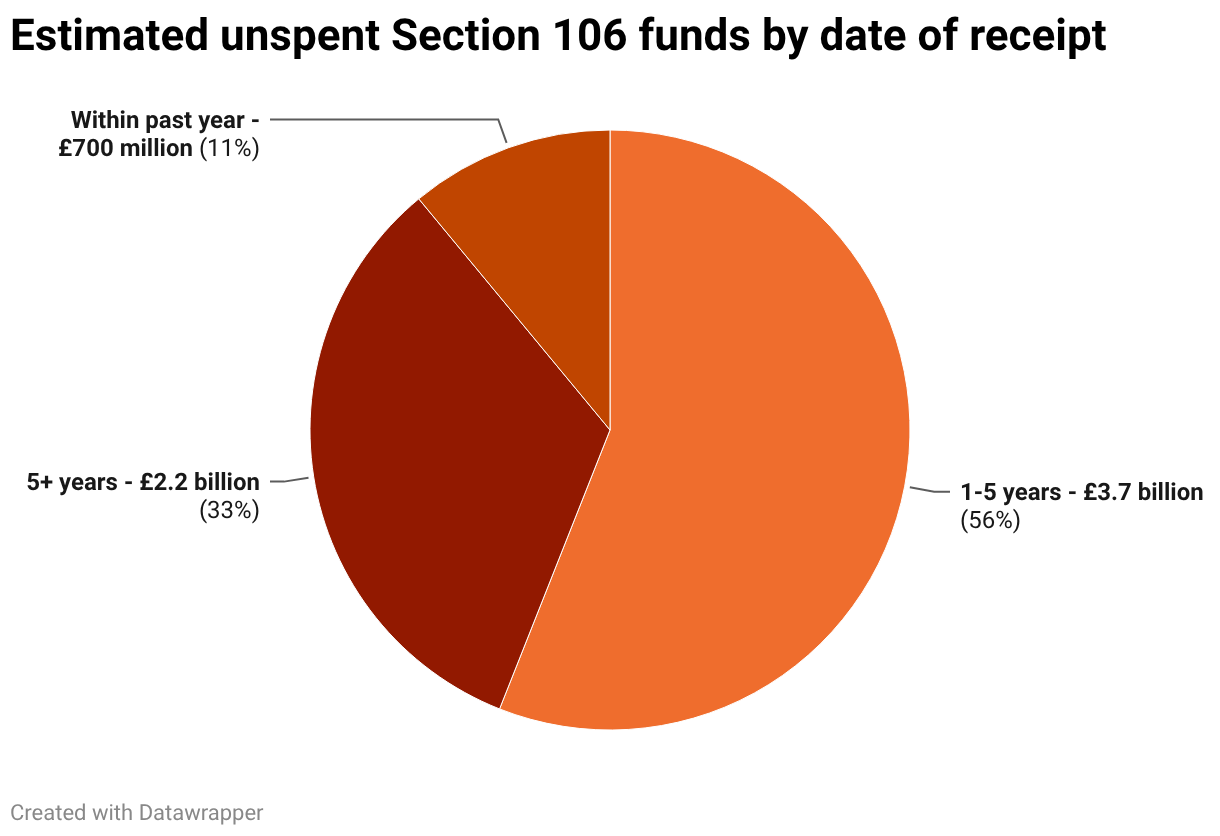
In addition, HBF’s FOI asked councils how long their unspent Section 106 funds have been held. While there is variation in the terms of agreements, it is standard practice for Section 106 funds to be spent within five years of payment.
However, a third of unspent Section 106 contributions have been held for longer than five years (March 2021 or earlier), up from a quarter in 2024.
When combined with Community Infrastructure Levy (CIL) funds - which exhibit a similar age profile – almost £3 billion of developer money is estimated to have been unspent for more than half a decade. In extreme cases, such as Oxfordshire County Council, funds are reported to have been held for more than two decades.
Returns to developers
Section 106 agreements can include return clauses, which require funds to be returned to developers if they are not spent within an agreed timeframe, typically five years.
However, HBF’s FOI responses show that these clauses are rarely used in practice. Over half of councils (56%) reported that they had not returned any Section 106 funds to developers in the past ten years. Across all responding local authorities, HBF estimates that only £65 million has been returned during this period, compared with an estimated £6.6 billion currently held unspent. In many cases, funds are not returned because they remain formally allocated to a specific project, even where delivery has been significantly delayed or has yet to commence.
Therefore, returns of contributions to developers are not the main reason infrastructure is failing to come forward. The home building industry’s clear preference is for contributions to be spent as intended and within appropriate timescales, as this ultimately benefits the residents in the new communities built by the developer.
Infrastructure Funding Statements: declining transparency
Finally, HBF’s FOI asked councils about their compliance with statutory reporting deadlines for Infrastructure Funding Statements (IFSs).
IFSs must be published every year before December 31 by local authorities in England. These documents set out developer contribution receipts for the most recent full financial year, as well as plans for future spending and unspent sums. IFSs are the main way in which developer contributions spending can be publicly scrutinised and accounted for.
However, councils are increasingly failing to publish these Statements before the Statutory deadline, making it more difficult for local communities to understand how funds are being spent.
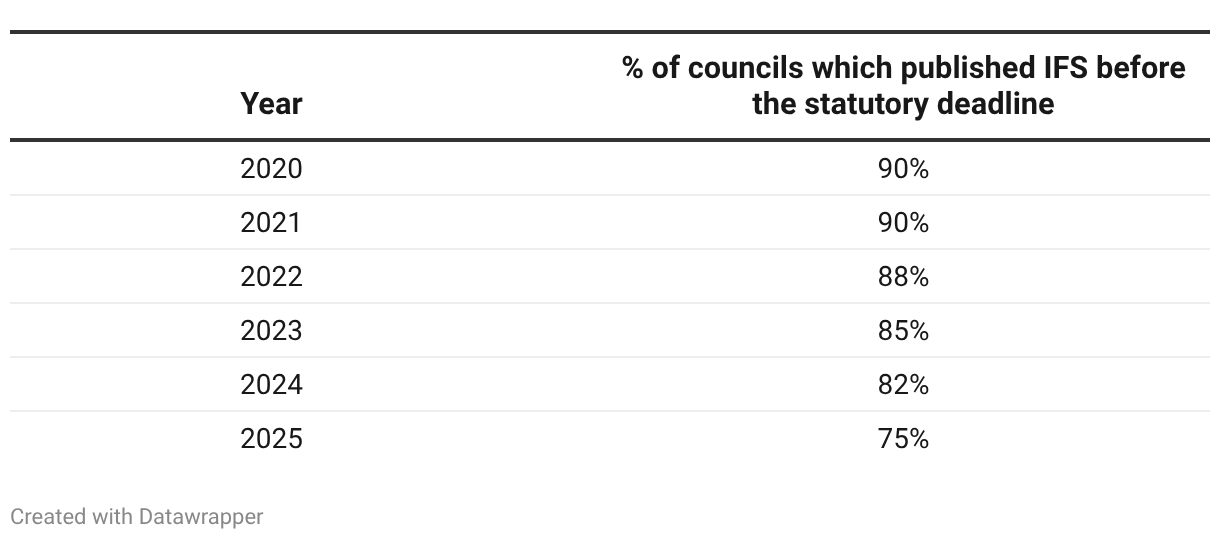
In 2020, the first year in which IFSs were required, 90% of local authorities published their IFS before the statutory deadline. However, in 2025 that fell to 75%, meaning a quarter of councils failed to publish details of their developer contributions accounts last year.
Based on a sample of around 60% of councils, HBF’s FOI shows that performance in meeting the statutory deadline has worsened every year since 2021:
While the precise causes of falling compliance are unclear, limited capacity and chronic understaffing within planning and infrastructure teams, alongside weak auditing and monitoring of developer contributions, are likely to be significant contributing factors.
Conclusions
Developer contributions build vital support for new developments among local communities by funding essential infrastructure and Affordable Housing. However, the evidence from HBF’s FOI exercise shows that there is a growing mismatch between the developer contributions councils hold and the timely delivery of new infrastructure and community amenities. £9 billion in developer contributions is estimated to be unspent, including around £3 billion held for more than five years, even though many agreements require spending within that timescale.
Where delays do occur, they are primarily caused by limited capacity and staffing within local authority planning and infrastructure teams, poor monitoring and auditing of funds, and the absence of a coherent local strategy for infrastructure delivery. These problems have been exacerbated since 2019, when the limit on the amount of Section 106 contributions that LPAs can ‘pool’ to fund the same infrastructure project was removed. While this can be useful, it has also meant that councils now wait longer for funds to accrue before delivering infrastructure.
The industry is concerned that this lack of timely delivery by some councils leaves residents unsure of the benefits that development has brought to their area, contributing to unfairly negative perceptions of new homes. This consent for new development is particularly vital at a time when the Government is seeking to increase output to deliver its 1.5 million homes ambition. Furthermore, it is concerning that councils sometimes cite infrastructure pressures as a reason to refuse new housing, even where sufficient funds already exist.
Recommendations
The Government and local authorities can go further to address these issues to ensure that communities can clearly see the tangible benefits of development:
Making better use of existing funds
- Existing unspent S106 and CIL payments must be taken into account when council objections to new planning applications cite concerns over infrastructure pressures. Pressure on local education and health services, for instance, should not be used as a reason for refusal if there are already sufficient funds held unspent to increase local public service capacity.
- There should be consideration of whether funds can be allocated to a different purpose if not spent after five years, so long as the developer agrees. Many councils argue that funds cannot be spent because the original purpose is no longer applicable, such as a lower demand for school places than predicted. There should be more flexibility to use funds for an alternative purpose in these circumstances, if agreed with the developer and without reopening the entire Section 106 agreement.
Transparency and accountability
- Infrastructure Funding Statements (IFS) should outline the reasons why developer contributions have not yet been spent and a breakdown of how long money has been held for. This can be done by amending the Schedule in the CIL Regulations 2019 that specifies what information needs to be included in IFSs. In addition, the amounts retained at the end of each financial year should be set out more clearly through an online summary of the IFS.
- A national government database of Infrastructure Funding Statements should be created. Such a database would not only allow for better comparison across councils, but would also ensure central government has oversight of which councils are underperforming or not publishing their IFS, and can step in when needed.
- A badging scheme, similar to blue plaques, should be introduced. This would ensure that new infrastructure and facilities funded by developer contributions are easily identifiable to the public.
Strengthening local authority capacity
- Local authority planning and infrastructure departments must be placed on a sustainable financial footing. This should include having sufficient resources to hire dedicated S106 and CIL monitoring officers. Furthermore, LPAs will, through the Planning and Infrastructure Act, be able to charge full cost recovery on planning services. Therefore, the performance of LPAs must be closely monitored to ensure that higher fees result in better performance, including performance in spending developer contributions in a timely and efficient manner, which is a key part of the service LPAs provide.
- CIL receipts should be pooled within Combined Authorities and merged councils following local government reorganisation. Pooling receipts could enable more strategic use of funds, create efficiencies, and reduce reliance on less predictable additional funding sources such as government grants.
- There must be coordination between local authorities and public service providers such as Integrated Care Boards. Better joint planning between councils and public service providers such as ICBs and schools will ensure contributions are requested, transferred and spent efficiently.
Ultimately, we hope that these recommendations will increase public understanding of developer contributions provision, speed up the delivery of infrastructure projects, and create a more informed, sensible debate about housing supply.