State of Play 2026/27
Challenges and opportunities facing small- and medium-sized home builders.
Contents
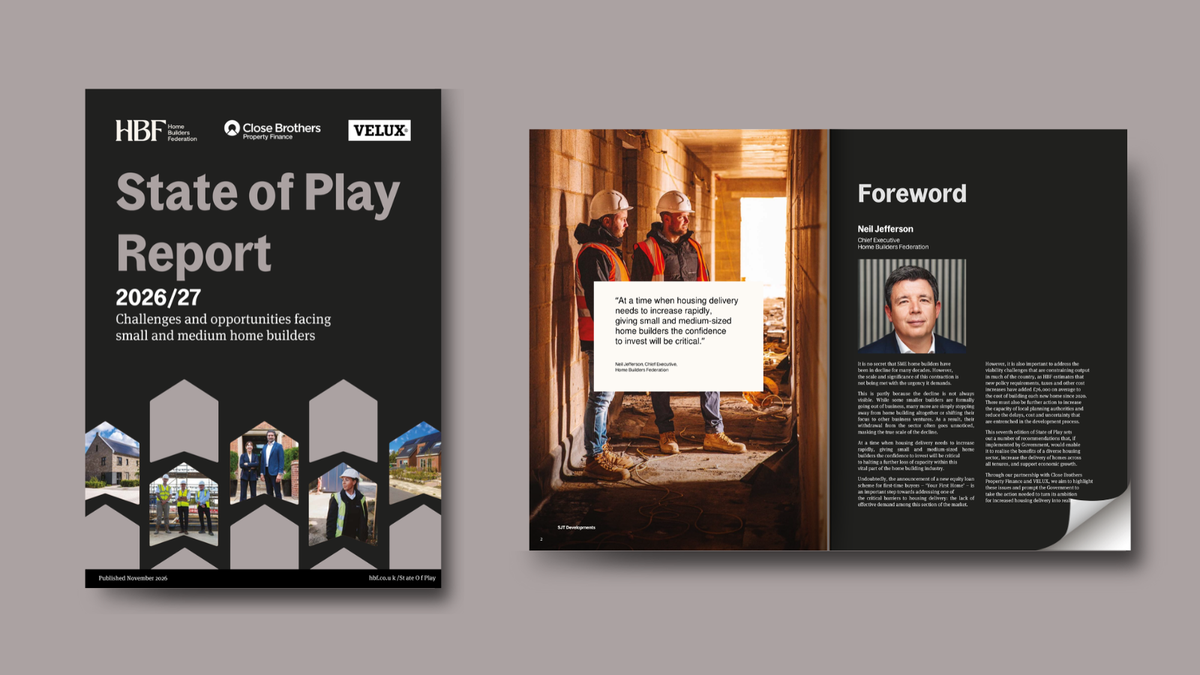
Foreword

“At a time when housing delivery needs to increase rapidly, giving small and medium-sized home builders the confidence to invest will be critical.”
Neil Jefferson, Chief Executive, the Home Builders Federation (HBF)
“At a time when housing delivery needs to increase rapidly, giving small and medium-sized home builders the confidence to invest will be critical.”
Neil Jefferson, Chief Executive, the Home Builders Federation (HBF)
It is no secret that SME home builders have been in decline for many decades. However, the scale and significance of this contraction is not being met with the urgency it demands.
This is partly because the decline is not always visible. While some smaller builders are formally going out of business, many more are simply stepping away from home building altogether or shifting their focus to other business ventures. As a result, their withdrawal from the sector often goes unnoticed, masking the true scale of the decline.
At a time when housing delivery needs to increase rapidly, giving small and medium-sized home builders the confidence to invest will be critical to halting a further loss of capacity within this vital part of the home building industry.
Undoubtedly, the announcement of a new equity loan scheme for first-time buyers – ‘Your First Home’ – is an important step towards addressing one of the critical barriers to housing delivery: the lack of effective demand among this section of the market.
However, it is also important to address the viability challenges that are constraining output in much of the country, as HBF estimates that new policy requirements, taxes and other cost increases have added £76,000 on average to the cost of building each new home since 2020. There must also be further action to increase the capacity of local planning authorities and reduce the delays, cost and uncertainty that are entrenched in the development process.
This seventh edition of State of Play sets out a number of recommendations that, if implemented by Government, would enable it to realise the benefits of a diverse housing sector, increase the delivery of homes across all tenures, and support economic growth.
Through our partnership with Close Brothers Property Finance and VELUX, we aim to highlight these issues and prompt the Government to take the action needed to turn its ambition for increased housing delivery into reality.

“It is encouraging, therefore, that the Government has made it a priority to restore confidence in the market through the announcement of the Your First Home scheme.”
Phil Hooper, Chief Executive, Close Brothers Property Finance
For seven years this report has sought to amplify the voice of SME home builders and present a clear, evidence-based case for greater Government assistance. From my conversations with SMEs, there is no doubt that the current market is one of the most challenging in decades. However, I am encouraged that there are signs that our calls are being heard.
Lack of support for first-time buyers has held the industry back ever since Help to Buy ended in 2023. Since then, we have consistently called upon the Government to reinstate a version of the equity loan. This year nearly three-quarters of respondents cited lack of support for first-time buyers as a major barrier to growth. It is encouraging, therefore, that the Government has made it a priority to restore confidence in the market through the announcement of the Your First Home scheme.
Another area where we have seen positive movement has been Biodiversity Net Gain (BNG). Previous editions of this report have addressed the disproportionate burden that these requirements place on the smallest sites. It is a welcome step that the Government has introduced an exemption for sites of 0.2 hectares or less and has granted smaller developments greater flexibility in how they meet BNG requirements.
Whilst these are undoubtedly positive steps, the findings in this report show how much pressure the sector is still under. Whilst the progress may not be as fast as we would like, it is a step in the right direction and a signal that the Government is listening. The challenge now is to make sure that the findings in this report are acted on.
Together with HBF and VELUX, it is a privilege to play a role in making sure SMEs’ voices are heard and pushing for the changes that will help them build more homes.

“The role SMEs play cannot be overstated. The bespoke design of their properties is regularly aligned with our business principles.”
Trevor Smith, National Housing Development Manager, VELUX
VELUX has long championed SME home builders and we are proud to join Close Brothers Property Finance and the Home Builders Federation as a partner on the State of Play report. I have always been impressed by the resilience SMEs show, especially in today’s market, which is arguably the toughest in living memory.
The role SMEs play cannot be overstated. The bespoke design of their properties is regularly aligned with our business principles of improving the health and well-being of residents – bringing in natural daylight, regulating circadian rhythms, and boosting indoor air. They build on smaller sites that volume builders pass over, bringing new homes to towns and villages often overlooked for new development, creating local jobs and apprenticeships. They are a vital component to the UK’s housing market, which is why we want to help make sure SMEs’ voices are heard at the highest level.
As a manufacturer, we know the pressure the supply chain is putting on businesses. In this report, 60% of SMEs describe the supply and cost of materials as a major barrier to growth, while 63% say construction material costs have increased significantly over the past year. For smaller firms, that makes already narrow margins even thinner.
We can play our part, working closely with SMEs on flexible solutions to manage cost pressures and meet new requirements in ways that work on smaller sites. But the industry also needs more support from Government. This report sets out clearly where help is most needed, from tackling cumulative viability pressures to making the planning system work for smaller sites.
The Government has made good on some of its promises to get the country building, but there is still a long way to go. If it wants more high-quality energy efficient homes, it needs a thriving SME sector to build them.
Introduction
With just over half of this Parliamentary term remaining before the next General Election, the Government has limited time to reverse the worsening fortunes of small and medium-sized (SME) home builders.
While the early days of Sir Keir Starmer’s premiership saw bold action to reform planning policy, including introducing the concept of grey belt and reinstating mandatory housing targets, this early progress was not matched by measures to address growing viability challenges or boost effective demand.
As such, it is perhaps unsurprising that some SME developers are declaring that “Over the past 12 months, we have faced the most challenging trading conditions experienced in decades”.
With a new Prime Minister in Andy Burnham, the Government has a fresh opportunity to make good on its commitment to boost housing delivery while advancing the ambition to deliver “good growth in every postcode”. But will they take it?
The early signs are encouraging. On the eve of his first party conference as Labour leader, Mr Burnham announced that the Government will be introducing a new equity loan scheme for first-time buyers, called Your First Home. While the impact of the scheme will ultimately depend on the specific parameters of the scheme including the property price caps, it is nevertheless a positive recognition by the new Prime Minister of the challenges the home building industry has been facing and the importance of overcoming them to achieve his broader ambitions around economic growth and Affordable Housing.
What is less certain is whether the Government has the political courage to make the changes necessary to support small and medium-sized developers, particularly where doing so may conflict with its other ambitions. Its decision not to allow developers to elect to make a payment in lieu of Affordable Housing on medium-sized sites – arguably its first real opportunity to ease the burden on SMEs – gives cause for scepticism.
With many SME home builders fighting for survival, the Government has no option but to move quickly and decisively to address the barriers facing their businesses if it wants to increase housing delivery of all tenures.
These barriers, and the action required from Government to address them, will be explored in detail throughout the remainder of this report.
Methodology
The 2026/27 edition of the State of Play report marks the seventh iteration of this comprehensive survey of SME home builders, conducted by the Home Builders Federation (HBF), Close Brothers Property Finance, and VELUX.
A total of 213 respondents completed the online survey between 2 June and 2 July 2026.
Regional split
Developers from all English regions, Wales and Scotland participated in the survey. However, no responses were received from Northern Ireland.
As in previous years, for the purposes of this report, the regions have been grouped as follows:
- North: North West, North East, Yorkshire, and Scotland
- Central: Midlands, East of England, and Wales
- South: South East, South West, and London

Size of company (by units built per annum)
The ‘SME’ category spans developers building anywhere from a handful of units to more than 100 each year. Our survey reflected this range, although the majority of respondents (59%) developed 50 units or fewer annually.

Length of trading
As demonstrated by the chart, 75% of respondents have been trading for more than 10 years, with 15% trading for between six and ten years. Respondents were therefore typically very experienced in the industry, with many having encountered multiple economic cycles.

Barriers to growth
With each passing year, the challenges facing SME home builders are not only increasing in number but are also becoming more complex and difficult to overcome.
Rising costs, increasing regulatory requirements, a lack of effective demand and persistent delays within the planning and development process are placing growing pressure on smaller home builders and their ability to bring forward new sites.
If the Government is serious about delivering the good homes the country needs while unlocking the growth that home building can generate, it must act urgently to address the barriers holding SME home builders back.
After all, a diverse and resilient home building industry will be essential to increasing housing supply of all tenures and ensuring that smaller builders can make their full contribution to meeting the country’s housing and economic ambitions.
This report identifies five of the most significant challenges currently hindering the delivery of much-needed new homes which the Government should prioritise:
- Delays in securing planning permission/discharging conditions – 88%
- Cumulative viability pressures – 82%
- Lack of resources in local authority planning departments – 81%
- Increasingly burdensome business taxation and regulatory environment – 72%
- Lack of Government support for first-time buyers – 72%
Without meaningful action to address these challenges, an ever-increasing number of SME home builders will simply fail to survive.
"I can only hope at some point we see progress on the many issues affecting our industry”
- Survey respondent

Planning
The planning system has undergone significant reform since the 2024 General Election, with the Government seeking to increase housing delivery through changes to housing targets, the introduction of ‘grey belt’ policy, reforms to planning fees and measures intended to support smaller sites. Further reforms were announced or implemented after this year’s survey, including the revised National Planning Policy Framework (NPPF), published in August 2026, and the national scheme of delegation, which came into force in October 2026.
For SMEs, these changes need to result in quicker decisions, fewer delays in discharging conditions and greater certainty when bringing sites forward. Securing an implementable planning permission often involves lengthy timescales, significant upfront costs and uncertainty, which SMEs are generally less able to absorb than larger home builders.
Planning delays
The experience of SME home builders suggests that changes to the planning framework have yet to translate into a consistently faster or more predictable process.
This year’s survey shows that the planning process remains a significant barrier to growth for SME developers, with 88% of respondents to our survey identifying delays in securing planning permission or discharging conditions as a major barrier to delivery. Planning delays were the top barrier to growth for the sixth year running, albeit down from 94% in last year’s survey.
This was consistent across the regions, with 90% of respondents in the Central region, 86% in the North and 85% in the South citing planning delays as a major barrier to housing delivery in the next 12 months.
Planning delays have a greater impact on smaller developers, which typically have fewer sites in their pipeline and less capacity to absorb unexpected delays, increasing the risk that sites are not brought forward in the first place.
“There are so many examples of planning decisions not happening within the statutory timescales. We now plan for a minimum of 12 months for a site to sit in the planning system, even for sites of under 10 dwellings”
– Survey respondent
Local planning authority resources
Alongside the wider complexity and lengthy timescales of planning applications, limited resources in local planning authority (LPA) departments and other public sector bodies remain a key cause of delay. 81% of respondents said LPA capacity was a major barrier to delivery, making this the third-biggest barrier overall.
HBF’s recent Planning on Empty research found that councils are operating at an average of just 80% of full staffing levels, with 90% of councils below full capacity. HBF estimates that 2,660 additional planners are now needed across England and Wales to address current shortfalls, up from 2,200 a year earlier1.

The Government is aware of this issue, and the Planning and Infrastructure Act 2025 gives LPAs the power to set their own fees, enabling full cost recovery and potentially creating a more sustainable funding model over time. In principle, this could help address capacity concerns within local authorities. However, the Government’s own assessment is that higher fees will disproportionately increase costs for small, micro, and medium-sized businesses submitting planning applications, potentially placing additional pressure on SME developers. Therefore, whether the additional fee income translates into improved capacity and performance without affecting the viability of smaller sites remains to be seen.
The Government has also introduced a national scheme of delegation, which is intended to ensure that smaller and more routine applications are determined by planning officers rather than planning committees. This could help reduce delays, although its impact will depend on LPAs having sufficient officer capacity to determine applications promptly.
Medium site category
Earlier this year, the Government proposed a new medium-site category for developments of 10-49 homes on sites up to 2.5 hectares, alongside a number of potential flexibilities and policy carve-outs intended to make bringing forward medium-sized sites easier. In this year’s survey, 50% of respondents said the introduction of a medium site category would make them somewhat or greatly more likely to bring forward new sites, while 43% said it would make little or no difference.

While the revised NPPF, published in August 2026, has introduced the new category of medium sites, these sites will not be subject to the wider carve-outs and flexibilities originally proposed. The industry had hoped for the ability to make cash payments in lieu of Affordable Housing contributions, and for medium sites to be exempt from the Building Safety Levy (BSL). Taken together, this means the potential benefits for SMEs of a medium site category are more limited than respondents may have anticipated when the survey was conducted.
Statutory consultees
The performance of statutory consultees continues to slow development, with 52% of respondents identifying it as a major barrier to growth. While this remains a significant concern, the proportion has fallen from 63% last year.
Positively, the Government has taken some action to improve the effectiveness of the statutory consultee system, including introducing a moratorium on the creation of new statutory consultees, removing statutory consultee status from The Gardens Trust and The Theatres Trust and narrowing the scope of applications on which Sport England must be consulted.
However, as the Government has rightly acknowledged, there is still further work to be done. As such, the industry has welcomed the Ministry of Housing, Communities and Local Government’s commitment to working with statutory consultees to develop a new performance framework, reduce the scope of advice provided by some of the largest statutory consultees and consult on how new powers for a surcharge on planning application fees to support key statutory consultees will be implemented.
As with many policy measures, the Government’s ability to ensure that these reforms adequately address the concerns faced by developers, and to implement them swiftly, will be critical to their success in removing this constraint on home building.
Viability
Viability has become one of the most significant challenges facing SME home builders. Planning delays remain the single biggest barrier to increasing housing delivery, but the latest survey shows that cumulative viability pressures have risen sharply in importance over the past year, moving into second place among the major barriers to growth.
Regulations, taxes and levies
HBF’s research finds that £76,000 has been added to the cost of building a home since 2020 – equivalent to around 20% of the average new build value. The £76,000 is made up of new building regulations, the Future Homes Standard, nutrient neutrality, Biodiversity Net Gain, and increased material and labour costs2.
82% of respondents identified cumulative viability pressures as a major barrier to increasing housing delivery over the next 12 months, up from 64% in 2025. Only 1% said viability was not a barrier at all.
It was encouraging to see the viability challenges facing development, and the subsequent impact on housing delivery, referenced by the Office for
Budget Responsibility (OBR) in its economic forecast published alongside the Government’s 2026 Budget. The OBR wrote “the weaker profile for housing supply in the near and medium term also partly reflects the cumulative effect of regulatory and fiscal changes outside the planning system over the last decade, particularly since 2019. These policy developments have increased the cost, complexity, and timescales associated with residential development. These include measures aimed at improving building safety, such as the Building Safety Levy and Building Safety Regulator regime, environmental requirements such as Biodiversity Net Gain and nutrient mitigation schemes, and wider fiscal measures including the residential property developer tax and higher corporation tax rates. Taken together, these measures appear to have weighed on house building activity to a greater extent than we had previously assumed”.
The scale of the issue is reinforced by the impact respondents perceive this to have on future housing delivery. 99% of respondents said viability pressures were reducing their ability to deliver new housing, with 70% saying they were significantly reducing delivery.

These findings suggest that viability is no longer simply an issue affecting individual marginal schemes. For many SMEs, the cumulative impact of higher costs, policy requirements, planning delays and weaker market conditions is affecting whether schemes can proceed at all.
For a development to be viable, the value generated by the homes must be sufficient to cover the costs of land acquisition, construction, finance, planning and regulatory requirements, Affordable Housing and other obligations, while still providing an appropriate return.
For many years, it has been assumed by policymakers that all rising development costs can be offset by adjustments to land values, and landowners would ultimately bear the costs of new policy requirements, taxes or cost increases by accepting a smaller receipt in exchange for the transfer of their land.
However, the scale of cost increases over the past six years has pushed this assumption to its limit. Land values can only fall so far before the supply of land for housing is compromised. In many areas, land values and negligible or negative house price inflation mean that securing land for residential development is no longer a sensible investment once the full costs of delivery are accounted for.
When asked specifically about the availability of viable small and medium-sized sites, 67% of respondents said that availability had worsened over the previous 12 months, including 49% who said it had worsened significantly. Only 8% believed availability had improved slightly, with just 1% saying it had improved significantly.
When asked whether they had been forced to make any changes to their business in the past 12 months as a result of viability or market pressures:
- Nearly two-thirds (63%) said they had ‘Delayed progressing a site or stopped work on site’
- 59% said they had ‘Reduced the number of new sites acquired’
- 43% said they had ‘Sought additional funding or refinancing’
- 41% said they had ‘Made redundancies or reduced the contracted workforce’

“Viability has become the single biggest issue affecting the housebuilding sector. Schemes that were originally financially viable are now becoming unviable due to a combination of rising construction costs, increased regulatory burdens, and prolonged planning delays.”
– Survey respondent
Looking ahead, the pressures are likely to continue to affect the pipeline of new development. 41% of respondents expect to reduce the number of sites they bring forward over the next 12 months, while 21% expect to exit certain markets or areas of development activity.

The Government’s confirmation at the 2026 Budget that it will not make major changes to building regulations for the remainder of this Parliament (except to continue improving building safety) is welcome. However, the Government should implement a moratorium on all new policy costs, taxes, and levies affecting home building and conduct a comprehensive review of cumulative regulatory impacts. This should include a proper assessment of the necessity of the Building Safety Levy, introduced on 1 October, given the billions already contributed to building safety and more than £2.5 billion remaining unallocated in the existing Building Safety Fund. Indeed, 38% of respondents said the Levy was already a major barrier to growth.
There should also be a suspension of any future rises to the Landfill Tax. While the industry welcomed last year’s decision not to introduce a single rate of Landfill Tax, the tax will still rise by around 500% by the end of this Parliament under current plans.
It must also be recognised by Government that additional policy costs, such as BNG, nutrient neutrality, and the Building Safety Levy, reduce the amount of value that can be captured for Section 106 funding and Affordable Housing. Even where sites remain viable, these increased costs reduce the amount that can go towards developer contributions. The industry is concerned that this is undermining the vital community support and local consent needed to support increased delivery and the Government’s ambitious housing targets.
“The Building Safety Levy should be halted as it would have a devastating impact on SME developers.”
– Survey respondent
Market
The challenges facing SME home builders are not confined to the supply side of the housing market. Buyer affordability is now having a significant impact on demand for new build homes, creating an additional constraint on delivery.
Over the last few years, a lack of consumer confidence due to a combination of economic pressures and rising interest rates has been compounded by the withdrawal of the Help to Buy Scheme in 2023. Sluggish demand feeds directly into reduced delivery, as developers are hesitant to bring forward new projects in an environment where homes are slower to sell. Unlike larger national home builders, smaller firms often lack the financial reserves to absorb long sales periods or to take on speculative development without certainty.
This year’s survey, which was carried out before the Prime Minister’s announcement of a new equity loan scheme for first-time buyers, found that 72% of respondents viewed the lack of Government support for first-time buyers as a major barrier to growth, up from 58% just a year ago. Furthermore, 70% identified mortgage interest rates and affordability as a major barrier.
When asked how buyer affordability was affecting demand, 95% of respondents said that affordability was constraining demand, with 67% saying it was significantly constraining demand. Only 3% responded that it was not constraining demand, with 0 respondents saying it was supporting demand.

This represents an important shift in the operating environment for developers. Even where a site has planning permission and a developer is ready to build, homes ultimately need to be sold. When potential buyers cannot secure a mortgage or raise the required deposit, sales rates can slow, increasing the amount of capital tied up in completed or part-completed homes.
The latest survey suggests that current market conditions have been affecting not just sales, but investment decisions further up the development pipeline. Nearly two-thirds of respondents have already delayed progressing a site or stopped work on site, while 59% have reduced the number of new sites acquired as a result of viability or market pressures.
“As the housing market has slowed, we have been forced to secure bridging finance to support completed housing stock that remains unsold, resulting in substantial interest costs.”
– Survey respondent
Your First Home scheme
It is therefore hugely welcome that the Government has recently announced the Your First Home scheme, a new equity loan scheme that will provide up to 20% loans towards deposits for first-time buyers, with buyer deposit contributions as low as 2.5%. The scheme has the potential to make a significant difference to households that would otherwise struggle to get onto the housing ladder and will also give builders the confidence to invest in future schemes and increase output.
Drawing on the evidence from its predecessor, Help to Buy, the introduction of Your First Home is expected to generate wider economic benefits. An independent evaluation of the Help to Buy Equity Loan scheme, published recently, estimated that the scheme generated a net present social value of £25.1 billion over its lifetime, in 2024/25 prices.
It is important that the scheme is implemented quickly, and that any income caps or property price caps are not overly restrictive. The scheme will also require a developer contribution, and this should be structured to ensure it is accessible for SMEs.
Stamp Duty Land Tax
To support the market, the Government should also consider proper reform of Stamp Duty Land Tax (SDLT). As it stands, the tax represents a high upfront cost for homebuyers and can act as a barrier to transactions, mobility and effective functioning of the housing market.
The reduction in first-time buyer SDLT thresholds from April 2025 further increased the upfront cost of purchasing a home. For households already facing significant deposit requirements, these additional transaction costs can affect purchasing decisions, leading some prospective buyers to delay or reconsider their plans to move.
This has consequences beyond individual purchasers. A healthy housing market depends on transactions taking place across different tenures and stages of the market. Supporting first-time buyers can unlock transactions further up housing chains, support demand for new homes and enable households to move to accommodation that better meets their needs.
Section 106 Affordable Housing
The Section 106 (S106) Affordable Housing market remains a persistent problem for builders of all sizes, but the issue is especially acute for SME developers.
Over the past few years, many home builders have struggled to secure bids from Registered Providers (RPs) for their S106 Affordable Homes, largely because of the financial pressures facing this part of the housing sector.
In January, the Government acted to address some of the issues affecting developers. This included a time-limited emergency route directing Local Authorities to allow the tenure of uncontracted S106 units to be varied where no RP is willing to buy them.
The success of the emergency route is debatable and obtaining suitable offers for S106 Affordable Homes remains a key barrier to delivery. Some 57% of SMEs said this was a major barrier, down only slightly from 58% last year, while a further 31% said it was a minor barrier to growth.
The issue is particularly acute in the Central and South regions, where 65% and 58% of SMEs respectively said obtaining suitable offers was a major barrier, compared with 45% in the North.
These findings highlight the ongoing constraints on delivering both S106 Affordable Homes and market sale units due to headwinds facing the RP sector. RPs often show limited interest in acquiring small numbers of S106 homes, particularly where schemes involve fewer than 30 units. This leaves smaller sites, and the developers building them, exposed to significant delivery risk.
As a result, some developers are deliberately targeting smaller sites than they otherwise would to avoid Affordable Housing requirements and the risk of being unable to secure an RP. This inevitably affects SME developers’ growth aspirations and reduces delivery of both private market housing and Affordable Housing.
In the worst cases, some SME home builders are unable to start on site at all. Many rely on project-based finance to maintain cash flow and begin construction, but without a contract to sell the S106 homes to an RP or local authority, accessing that finance can be impossible. For some SME developers, this barrier may be insurmountable and could threaten the viability of their businesses.
To prevent the issue from worsening and to provide a backstop for new developments if an RP buyer cannot be found, the new template S106 agreement for medium sites should include a mandatory cascade mechanism as a default.
“The Affordable Housing provider pulled out of a deal the day before exchange of contracts was due to take place due to a ‘change in their model’. We believe funding issues were more likely. This resulted in a loss of legal fees circa £10k on our part and then having to re-engage with the local authority to change tenure and then get S106 amended for a change in tenure for the homes, costing us a further £6-8k with local council and solicitors on top of what was already lost.”
– Survey respondent
Cost of essentials: Land, labour and materials
Alongside government taxes, levies and policy costs, the cost and availability of essential inputs – land, labour, materials and energy – continue to hinder development viability and the growth of SME home building businesses.
Higher material and energy costs increase build costs, while labour shortages constrain capacity, and limited land supply makes it harder for SMEs to bring forward new sites.
Material costs and the supply chain
Over the past five years, unusually high inflation – driven by Brexit, the COVID-19 pandemic, geopolitical upheaval, supply chain pressures and broader economic uncertainty – has rapidly increased material and labour costs across the home building industry.
To put these challenges into context, inflation in relevant building materials has exceeded 40% since 2020, adding £28,500 on average to the cost of building a new home3.
This year’s survey suggests that these cost pressures are set to intensify further, driven in part by recent events in the Middle East and their impact on supply chains, including higher material and fuel costs.
Overall, 99% of respondents said the supply and cost of materials was a barrier to delivery, including 60% who described it as a major barrier. This represents a significant increase from last year’s survey, when 41% said the cost of materials was a major barrier to delivery of new homes.
In the North of England, where viability is already more challenging than in many other parts of the country, over 70% of respondents said the supply and cost of materials was a major barrier to the growth of their business.

This trend is also reflected in reported cost increases over the past 12 months: 63% of respondents said construction material costs had increased significantly, while a further 34% said they had increased moderately over the past year.

For SME developers, these pressures have direct consequences for housing delivery and the growth of their businesses. When asked about the most significant impact of supply chain pressures on their business, 49% cited the cost and availability of materials – the most common response. Respondents also commonly cited developments being halted or delayed, cash flow disruption and direct financial losses.
These findings underline that smaller developers often have less financial resilience than larger home builders and can find it more difficult to absorb sudden cost increases or limited availability of supplies caused by supply chain disruption.

Energy costs
Energy costs form another important part of the overall cost base for new homes, affecting construction activity directly while also feeding into the price of materials and transport. For the first time this year, respondents were asked whether they considered energy costs to be a barrier to the growth of their businesses.
Overall, 91% of respondents cited energy costs as a barrier to delivery, reflecting the broader inflationary pressures that have affected development viability in recent years. However, most respondents viewed energy costs as a minor rather than major barrier, with 54% describing them as a minor barrier.
Concerns about energy costs appear to be closely linked to wider economic uncertainty and, with energy costs already having risen this year and further increases expected, it is unsurprising that 99% of respondents also identified geopolitical uncertainty as a barrier to delivery. For SMEs, uncertainty caused by
events such as those in the Middle East can create additional caution and risk when assessing whether to bring forward new schemes.
Labour costs and skills
Wider cost increases and pressures are also evident in the labour market. Labour costs have increased by 23% since 2020, adding an average of £8,500 to the cost of building a home and reflecting wider adjustments in the labour market4. This year’s survey shows that 92% of respondents believe the supply and cost of labour is a major or minor barrier to growth, up from 88% last year.
There was a significant regional disparity, however, with 57% of respondents in the North saying the supply and cost of labour was a major barrier, compared to just 26% in the Midlands and 33% in the South.

These immediate cost pressures sit alongside a longer-term skills challenge. Around 25% of the existing home building workforce is over 50, meaning the sector is facing an impending retirement cliff edge. At the same time, too few recruits are entering the sector through education and training routes to replace them. There has also often been a lack of Government understanding of critical future skills needs, including green skills.
For SMEs, the problem is particularly challenging. Employing overseas workers requires organisations to obtain a sponsor licence, a process that is expensive, time-consuming and bureaucratic. With much of the subcontractor workforce made up of small and medium-sized businesses, this creates a significant administrative burden and can limit the ability of smaller firms to respond quickly to labour shortages.
Looking ahead, the labour constraint could become more acute if demand picks up and the Government’s planning reforms begin to have a positive effect on housing supply. HBF research has found that for every 10,000 new homes built, the industry needs 30,000 recruits, including 2,500 bricklayers, 2,500 groundwork and plant operatives, and 1,000 carpenters. Without sufficient workforce capacity, increased permissions may not translate into delivery at the pace required.
The industry is responding to these challenges, including through the publication of a Sector Skills Plan last year, which provides a clear roadmap for tackling longstanding workforce challenges.
However, more needs to be done to ensure the sustainability and longevity of the home building workforce.
“Combined pressures have resulted in the difficult decision to make 18% of our workforce redundant.”
– Survey respondent
Political understanding of the home building industry and housing delivery
The conditions in which home builders operate, and their ability to deliver new homes, are shaped significantly by the policies, legislation and taxes introduced by policymakers.
From Building Regulations and the National Planning Policy Framework (NPPF) to employment taxes, skills policy and support for first-time buyers, political decisions influence every stage of the development process and can have a profound impact on the sector’s capacity to build.
It is therefore vital that policymakers understand the economic model underpinning the home building industry and the consequences of the decisions they make. To inform this report’s recommendations to Government, survey respondents were asked what they most wished politicians better understood about home building. The top two most frequently cited issues were:
- The misconception that land values can absorb unlimited policy and regulatory costs. In reality, high costs can render sites unviable and prevent land from coming forward for development – cited by 72% of respondents.
- The cumulative impact of planning obligations, taxation and regulatory requirements on development viability – cited by 71% of respondents.

These findings are consistent with the wider results of this year’s survey. As previously mentioned, over the past six years, the growing burden of taxes, levies and regulatory requirements, along with rising materials and labour costs, has added an estimated £76,000, on average, to the cost of building a new home5.
This lends considerable weight to the industry’s concern that policymakers do not always fully appreciate the economics of development or the cumulative impact of individual policy decisions – particularly in light of the Government’s decision to proceed with the Building Safety Levy (BSL), despite industry warnings about its implications for SME developers’ ability to bring forward new homes.
Ensuring politicians across the political spectrum understand and support the case for new housing is critical if we are to shift the rhetoric around housing and deliver much needed homes across the country.
“Excessive state interference in business is killing our economy. Legislators who legislate without appreciating what they are piling on to business are naive if they think this will stimulate growth – quite the opposite.”
– Survey respondent
Other issues
This report has explored in depth the main barriers to housing delivery for SME developers. However, many other issues are also hindering the supply of new homes, including:
- Geopolitical uncertainty – The ongoing geopolitical uncertainty due to the war in Iran was considered a barrier to growth by almost all respondents (99%). 60% cited it as a major barrier.
- Implementation of Biodiversity Net Gain – considered by 91% of respondents to be a barrier to growth. For 45%, it is a major barrier.
- Opposition to development – 94% of respondents reported that political and/or local opposition to development was a barrier to delivery, with 55% considering it a major barrier.
- Infrastructure – 86% of respondents considered delayed electricity grid connections as a barrier to growth, with 42% citing it a major barrier. A further 91% considered the cost and timescales involved in the provision and adoption of utilities and infrastructure to be a barrier to growth, with 47% declaring it a major barrier.
- Wastewater connections – 79% of respondents said delays in securing wastewater connections are a barrier to growth, with 22% considering it a major barrier.
Other notable findings included:
- Two-fifths of respondents (40%) said access to development finance is not a barrier to growth. 39% said it was a minor barrier to growth and 21% a major barrier, down from 26% last year.
- The percentage of respondents citing nutrient and/or water neutrality restrictions as a major barrier to growth has fallen from 33% in 2025 to 16% in 2026.
Recommendations
Following the closure of the survey, the findings were shared and discussed with SME developers at roundtable events in London (August 2026) and Manchester (September 2026).
Those discussions resulted in a set of recommendations across four key areas.
Together, they reflect the views and experiences of smaller home builders and identify the practical and tangible changes that could make the greatest difference to their ability to bring forward and deliver new homes.
Address the viability pressures that are hindering the supply of new homes
- Implement a moratorium on further new policy costs, taxes and levies on home building.
- Undertake a comprehensive analysis of the unprecedented increase in policy costs imposed on home building from across various government departments in the past few years.
- Repeal the Building Safety Levy, introduced in October 2026, that is adding thousands of pounds of costs to the delivery of each new home.
“I’d suggest we should pause ALL regulation for five years so the industry can work through the cost implications.”
– James Parkin, Managing Director at Wheeldon Brothers
“I would say the removal of developer contributions on sites under 49 or such lower number as they think appropriate would be our one ask.”
- William Togher, Founder and Managing Director at Kidbrook Homes
Turn underlying demand into effective demand
- Introduce the Your First Home scheme quickly and ensure it works for buyers across the country and home builders of all sizes.
- Restore the first-time buyer Stamp Duty Land Tax (SDLT) thresholds that applied before April 2025
- Undertake a review of the economic impact of SDLT.
“I would say that the one ask would be for a demand-side intervention from Government along the lines of an equity loan scheme."
- Glen Eaton, Director at Peter David Homes
“Stamp duty reform. However, this has to be done sensibly or will likely stall the market while people wait for it to come into force.”
- Jason Vince, Managing Director at Earlswood Homes
Make the planning process work for SME developers
- Simplify planning requirements and reduce unnecessary complexity for SME developers.
- Increase long-term funding for local planning authorities to allow councils to recruit and retain permanent and more senior planning staff, rather than relying on short-term or project-based solutions.
- Developers have shared examples of spending significant sums on technical reports and design work, only to discover late in the process that schemes would not be supported in their proposed form. Greater certainty earlier in the planning process would save considerable time and cost.
- Local planning authorities should adopt a more customer-focused approach to enable better collaboration with developers.
“Make the planning system genuinely proportionate for SME house builders, with faster decisions and greater certainty on costs and requirements. For smaller developers, time and uncertainty can make the difference between a site being viable or not – and removing those barriers would unlock more homes.”
- Eleanor Deeley, Joint Managing Director at Deeley Group
Fix the challenges in the Section 106 Affordable Housing market
- Make cascade mechanisms a standard feature of Section 106 agreements. This would provide developers, Registered Providers and lenders with greater certainty, while prioritising the delivery of Affordable Housing through alternative tenures where the originally agreed tenure cannot be secured.
- Reconsider the decision not to allow developers of medium-sized sites to elect to make a financial contribution in lieu of on-site Affordable Housing provision.